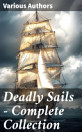
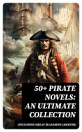
Deadly Sails - Complete Collection: History of Pirates, Trues Stories about the Most Notorious Pirates & Most Famous Pirate Novels
Jules Verne · Charles Dickens · Robert Louis Stevenson · James Fenimore Cooper · Edgar Allan Poe · William Hope Hodgson · Charles Kingsley · Howard Pyle · Jack London · Arthur Conan Doyle · Walter Scott · Alexandre Dumas · Frederick Marryat · Washington Irving · Harold MacGrath · Joseph Lewis French · William Clark Russell · Harry Collingwood · Max Pemberton · Charles Boardman Hawes · L. Frank Baum · J. M. Barrie · R. M. Ballantyne · G. A. Henty · J. Allan Dunn · Robert E. Howard · F. Scott Fitzgerald · W. H. G. Kingston · Charles Johnson · Maturin Murray Ballou
Nov 2023 · DigiCat
Ebook
11553
Pages
family_home
Eligible
info
About this ebook
Deadly Sails - Complete Collection stands as a compelling convergence of seafaring tales masterfully crafted by a panoply of literary giants. This anthology captures the tumultuous dance of oceans and men, where adventures veer into suspenseful encounters and reflections on power, ambition, and survival surface as prominent themes. The assemblage of stories, ranging from high-seas adventure to the eerie tension of maritime lore, highlights a kaleidoscope of literary styles, combining romantic prose with gothic atmospheres and thrilling narratives. The anthology balances strategic genius with the maritime mystique, promising a page-turning journey through uncharted waters. The contributors to this collection are a veritable who's who of literary history, including revered figures such as Jules Verne and Edgar Allan Poe, whose explorations of the human spirit against the vastness of the sea resonate deeply with readers. The anthology bridges centuries of maritime storytelling, from the rollicking adventures of R.M. Ballantyne and Howard Pyle to the psychological depths plumbed by F. Scott Fitzgerald and Charles Dickens. Together, these authors articulate a shared legacy of nautical fascination, woven across diverse cultural and temporal backdrops, inviting profound engagement and enlightened reflection. For those seeking a multifaceted exploration of maritime themes, Deadly Sails offers an unparalleled voyage. It presents an invaluable opportunity to traverse the broader seas of human emotion and ingenuity, offering the reader a unique vantage point from which to observe the dynamics of adventure and introspection. The collection promises educational enrichment while broadening one's appreciation of the interplay between narrative diversity and thematic unity. By immersing oneself in this anthology's rich tapestry of voices, readers are invited to participate in an enduring dialogue with some of literature's most enduring storytellers.
Deadly Sails - Complete Collection stands as a compelling convergence of seafaring tales masterfully crafted by a panoply of literary giants. This anthology captures the tumultuous dance of oceans and men, where adventures veer into suspenseful encounters and reflections on power, ambition, and s...
Discover more
About the author
Jules Verne (1828–1905), a French novelist, poet, and playwright, is often referred to as the 'Father of Science Fiction.' His literary creations laid the groundwork for modern speculative fiction, merging adventurous tales with futuristic technology and scientific inventions, aspects which had yet to be fully realized during his lifetime. Verne's prodigious body of work has transcended time, with his Voyages extraordinaires - a sequence of more than fifty novels including renowned titles such as 'Twenty Thousand Leagues Under the Sea' (1870), 'Journey to the Center of the Earth' (1864), and 'Around the World in Eighty Days' (1873) - that encapsulates his far-reaching imagination and exploration of the unknown. Verne's narratives often feature travel and adventure, as seen in 'Deadly Sails - Complete Collection,' where the sea stands as both a wonder and a threat, embodying his fascination with maritime knowledge and voyages. Through his literature, Verne not only sought to educate but also to entertain, utilizing a writing style that combines detailed scientific and geographical information with relentless pace and excitement. His impact on the literary canon and pop culture is monumental, rendering his work continuously relevant in discussions of literary accomplishments within the genres of science fiction and adventure. Verne's legacy persists through the ceaseless adaptation and enjoyment of his stories.
Jules Verne (1828–1905), a French novelist, poet, and playwright, is often referred to as the 'Father of Science Fiction.' His literary creations laid the groundwork for modern speculative fiction, merging adventurous tales with futuristic technology and scientific inventions, aspects which had y...
Rate this ebook
Tell us what you think.
Reading information
Smartphones and tablets
Install the Google Play Books app for Android and iPad/iPhone. It syncs automatically with your account and allows you to read online or offline wherever you are.
Laptops and computers
You can listen to audiobooks purchased on Google Play using your computer's web browser.
eReaders and other devices
To read on e-ink devices like Kobo eReaders, you'll need to download a file and transfer it to your device. Follow the detailed Help Center instructions to transfer the files to supported eReaders.