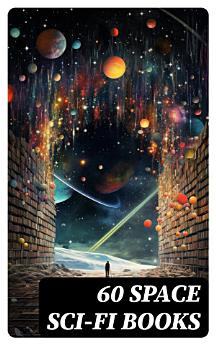
60 Space Sci-Fi Books: Intergalactic Wars, Alien Attacks & Space Adventures: Space Viking, A Martian Odyssey, Triplanetary...
Jules Verne · Percy Greg · David Lindsay · Edward Everett Hale · John Jacob Astor · Murray Leinster · H. Beam Piper · Frederik Pohl · Fritz Leiber · Irving E. Cox · Philip K. Dick · Richard Stockham · H. G. Wells · E. E. Smith · Edwin Lester Arnold · Gustavus W. Pope
Dec 2023 · DigiCat
Ebook
7358
Pages
family_home
Eligible
info
About this ebook
Delve into the compelling cosmos of '60 Space Sci-Fi Books,' a masterful anthology that encapsulates the spirit of adventure and exploration that defines space science fiction. This expansive collection presents a kaleidoscope of stories ranging from the imaginative voyages of Jules Verne to the dystopian visions of Philip K. Dick. Within these pages, the reader will encounter a multitude of literary styles that traverse futuristic worlds, alternative realities, and the ever-fascinating possibility of extraterrestrial life. From fascinating tales of cosmic odysseys to mind-bending narratives of time travel, each piece is a testament to the timeless allure of the genre. The anthology draws from the creative wells of venerated authors who have collectively shaped science fiction's literary landscape. Writers like H.G. Wells and E.E. Smith have pioneered narratives that challenge and exhilarate, while others such as Frederik Pohl and Murray Leinster offer works that reflect the sociopolitical and technological anxieties of their times. The inclusion of multifaceted voices from across different eras lays a rich tapestry of space-inspired storytelling that speaks to the genre's evolution, enabling the anthology to connect with historical and modern audiences alike. Readers are invited to embark on a literary journey that spans galaxies and explores the human condition through speculative fiction. With such a diverse constellation of narratives at their disposal, those who open this collection will be treated to a plethora of unique viewpoints and scenarios that spark the imagination and challenge preconceptions. Whether for educational purposes or pure enjoyment, '60 Space Sci-Fi Books' promises a thought-provoking engagement with the genre's best, providing a wellspring of insights into both the known and unknown universes.
Delve into the compelling cosmos of '60 Space Sci-Fi Books,' a masterful anthology that encapsulates the spirit of adventure and exploration that defines space science fiction. This expansive collection presents a kaleidoscope of stories ranging from the imaginative voyages of Jules Verne to the ...
Discover more
About the author
Jules Verne (1828–1905), a pioneering French novelist, is often referred to as the father of science fiction. His extraordinary ability to blend scientific knowledge with pulsating adventure narratives established a new frontier in literature. Verne's foresight in predicting future technological advancements has been a hallmark of his work; he gave his audiences unprecedented access to undersea worlds, uncharted lands, and the realm of space, long before the actual explorations occurred. Although '60 Space Sci-Fi Books' does not correspond to any actual title of his works, Verne's contributions to the genre include the well-known classics 'From the Earth to the Moon' (1865), 'Around the Moon' (1870), and 'Twenty Thousand Leagues Under the Sea' (1870). His vividly described technological contrivances, like the iconic submarine Nautilus, and the spacecraft Columbiad, have left indelible marks in literature and history. Verne's fiction was rooted in the scientific advancements of his time, but his imaginative leap and meticulous research fostered books that appealed to both the layman and the scientist. His voyages extraordinaires—a series of more than sixty works—were instrumental in establishing a literary style that seamlessly intersperses pedagogic information within the fabric of thrilling narratives, thereby making learning about distant worlds and future possibilities an exciting venture for readers of all ages.
Jules Verne (1828–1905), a pioneering French novelist, is often referred to as the father of science fiction. His extraordinary ability to blend scientific knowledge with pulsating adventure narratives established a new frontier in literature. Verne's foresight in predicting future technological ...
Rate this ebook
Tell us what you think.
Reading information
Smartphones and tablets
Install the Google Play Books app for Android and iPad/iPhone. It syncs automatically with your account and allows you to read online or offline wherever you are.
Laptops and computers
You can listen to audiobooks purchased on Google Play using your computer's web browser.
eReaders and other devices
To read on e-ink devices like Kobo eReaders, you'll need to download a file and transfer it to your device. Follow the detailed Help Center instructions to transfer the files to supported eReaders.