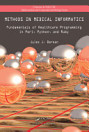
Methods in Medical Informatics: Fundamentals of Healthcare Programming in Perl, Python, and Ruby

· CRC Press
1 review
Ebook
413
Pages
Eligible

About this ebook

Too often, healthcare workers are led to believe that medical informatics is a complex field that can only be mastered by teams of professional programmers. This is simply not the case. With just a few dozen simple algorithms, easily implemented with open source programming languages, you can fully utilize the medical information contained in clini
Too often, healthcare workers are led to believe that medical informatics is a complex field that can only be mastered by teams of professional programmers. This is simply not the case. With just a few dozen simple algorithms, easily implemented with open source programming languages, you can ful...

Discover more

Ratings and reviews

1 review
A Google user
March 6, 2011
The book is addressed to healthcare workers (students, physicians or researchers) who have basic programming skills, and are interested to use these skills to help their patients, or to advance the medical science. The author includes in this work fundamental algorithms and methods of medical informatics with application to medical data sets, as well as step-by-step instruction and concrete examples. The script examples provided work both on Windows based PCs and on Macs and are excellent resources even for beginners who are not very familiarized with any of the three programming languages (Perl, Phyton or Ruby). In addition, this book provides references to excellent public medical data resources, covers some of the computational methods of biomedical informatics, including autocoding, data scrubbing and data deidentification. The author also included examples of questions that biomedical scientists can address, in relation to medical data and open source programming language. He maintains a Website with updated resources related to all his published books. In the context of a new era of medicine with widespread implementation of electronic medical records and electronic health records, this textbook is an invaluable resource.
Did you find this helpful?

About the author

Jules Berman, Ph.D., M.D., received two bachelor of science degrees (mathematics and earth sciences) from MIT, a Ph.D. in pathology from Temple University, and an M.D. from the University of Miami School of Medicine. His postdoctoral research was conducted at the National Cancer Institute. His medical residence in pathology was completed at the George Washington University School of Medicine. He became board certified in anatomic pathology and in cytopathology, and served as the chief of Anatomic Pathology, Surgical Pathology and Cytopathology at the Veterans Administration (VA) Medical Center in Baltimore, Maryland.

While at the Baltimore VA, Dr. Berman held appointments at the University of Maryland Medical Center and at theJohns Hopkins Medical Institutions. In 1998, he became the program director for pathology informatics in the Cancer Diagnosis Program at the U.S. National Cancer Institute. In 2006, he became president of the Association for Pathology Informatics. Over the course of his career, he has written, as first author, more than 100 publications, including five books in the field of medical informatics. Today, Dr. Berman is a full-time freelance writer.
Jules Berman, Ph.D., M.D., received two bachelor of science degrees (mathematics and earth sciences) from MIT, a Ph.D. in pathology from Temple University, and an M.D. from the University of Miami School of Medicine. His postdoctoral research was conducted at the National Cancer Institute. His me...

Rate this ebook

Tell us what you think.

Reading information

Smartphones and tablets
Install the Google Play Books app for Android and iPad/iPhone. It syncs automatically with your account and allows you to read online or offline wherever you are.
Laptops and computers
You can listen to audiobooks purchased on Google Play using your computer's web browser.
eReaders and other devices
To read on e-ink devices like Kobo eReaders, you'll need to download a file and transfer it to your device. Follow the detailed Help Center instructions to transfer the files to supported eReaders.