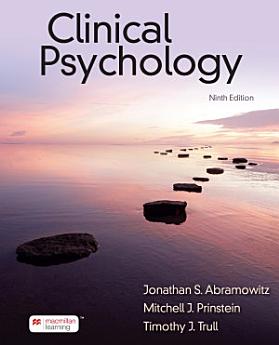
Clinical Psychology: A Scientific, Multicultural, and Life-Span Perspective, Edition 9
About this ebook
About the author
Jonathan S. Abramowitz is Professor of Psychology and Neuroscience, and Director of Clinical Training at the University of North Carolina at Chapel Hill (UNC-CH). He also serves as Direc-tor of the UNC-CH Anxiety Clinic. Jon earned his PhD in clinical psychology at the University of Memphis in 1998 and has been at UNC-CH since 2006. His research and clinical interests focus on anxiety and related disorders, including obsessive-compulsive disorder (OCD), and he has received international recognition, honors, and awards for his scientific, clinical, and professional contributions in these areas. Most recently, he was awarded the University of North Carolina Faculty Award for Excellence in Doctoral Mentoring. Working with many students and collaborators, he has published over 300 research articles, book chapters, encyclopedia entries, and books. Jon served as President of the Association for Behavioral and Cognitive Therapy (ABCT) from 2015 to 2016 and founded (and served as the first Editor-in-Chief of ) the Journal of Obsessive-Compulsive and Related Disorders. His previous positions include Assistant/Associate Professor at the Mayo Clinic and Mayo School of Medi-cine (2000-2006), and Postdoctoral Fellow and Instructor at the University of Pennsylvania (1999–2000).
Dr. Mitchell J. Prinstein is the Chief Science Officer of the American Psychological Association and John Van Seters Distinguished Professor of Psychology and Neuroscience at the University of North Carolina at Chapel Hill. For over 25 years, Mitch’s research has examined interpersonal models of internalizing symptoms and health risk behaviors among adolescents, with a specific focus on the unique role of on- and off-line peer relationships in the developmental psycho-pathology of depression and self-injury. He has published over 150 peer-reviewed papers and 9 books, including graduate volumes on assessment and treatment in clinical child and adoles-cent psychology, a set of encyclopedias on adolescent development, and the acclaimed trade book, “Popular: Finding Happiness and Success in a World That Cares Too Much About the Wrong Kinds of Relationships.” He is a past Editor for the Journal of Clinical Child and Adoles-cent Psychology, a past-president of the Society for the Science of Clinical Psychology and the Society of Clinical Child and Adolescent Psychology, and served on the Board of Directors of the American Psychological Association. Mitch has received several national and university-based awards recognizing his contributions to research, classroom instruction, for profes-sional development training, as a mentor, and for his national contributions to education and training at the local, state, and national level. Mitch and his work have been featured in over 200 pieces in The New York Times, The Wall Street Journal, National Public Radio, the Los Angeles Times, CNN, U.S. News & World Report, Time magazine, New York magazine, News-week, Reuters, Family Circle, Real Simple, All Things Considered, and in two TEDx talks.
Dr. Timothy Trull is the Curator’s Professor of Psychological Sciences and Byler Distinguished Professor at the University of Missouri–Columbia. He enjoys teaching a variety of courses in clinical psychology, particularly Introduction to Psychopathology and Introduction to Clin-ical Psychology, as well as supervising clinical psychology graduate students in their research, assessment, and clinical work. Tim earned his MA and PhD in clinical psychology at the University of Kentucky. Tim publishes much of his research in the Journal of Abnormal Psychology (now called Journal of Psychopathology and Clinical Science), Psychological Assessment, and the Journal of Personality Disorders. Sponsored through grants from the National Institute of Health, the National Institute on Alcohol Abuse and Alcoholism, and the Borderline Personality Disorder Research Foundation, his research projects include evaluating etiological models of borderline personality disor-der, exploring the relations between personality disorders and substance use disorders, assessing genetic and environmental influences on personality and psychopathology, and using ambulatory assessment in clinical psychology. In addition to his work at the university, Tim is a member of the scientific faculty at the Missouri Center for Addiction Research and Engagement (MOCARE) and is a practicing clinical psychologist. He has won a number of awards that include Outstanding Alumnus, University of Kentucky; the Graduate Faculty Mentoring Award, University of Missouri; the Robert S. Daniels Junior Faculty Teaching Award; and the Psi Chi Professor of the Year. Tim is a Fellow of the American Psychological Association and the Association for Psychological Science.