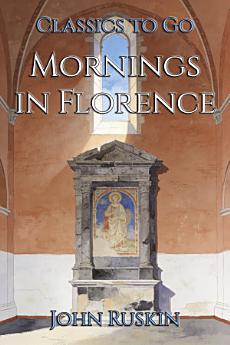
Mornings in Florence: Restored Classics to Go Edition

· Otbebookpublishing
Ebook
170
Pages
Eligible

About this ebook

Ruskin leads the reader into Florence's Santa Croce with the urgency of a guide who knows that true seeing must be learned. Beginning in the Bardi chapel, he points to Giotto's frescoes as works best approached with patience, historical awareness, and an eye trained to look past damage and restoration. From there, the chapter widens into a vivid meditation on Florence itself: a city shaped by Franciscan and Dominican reform, by preaching, sacrifice, and the artistic force of Giotto, Arnolfo, and Dante. Santa Croce is praised not for splendor but for its original purpose as a church of prayer, burial, and humble use, its cross-shaped plan read as an emblem of suffering rather than triumph. The passage then turns inward to Florence's sculptural and pictorial treasures, especially the tomb of Galileo de' Galilei, which becomes a lesson in noble art, public virtue, and the difference between truthful carving and empty imitation. Giotto's frescoes are examined in detail, from tender, clear color to the moving figure of St. Louis, while the text also reflects on sacred legend, righteous kingship, and divine providence through St. Louis, Brother Giles, Cyrus, and Isaiah. This edition has been fully restored with modern typesetting, custom cover design.
Ruskin leads the reader into Florence's Santa Croce with the urgency of a guide who knows that true seeing must be learned. Beginning in the Bardi chapel, he points to Giotto's frescoes as works best approached with patience, historical awareness, and an eye trained to look past damage and restor...

Discover more

About the author

John Ruskin was one of the most influential Victorian writers, critics, and thinkers, born in London in 1819 and shaped by a childhood of intense reading, travel, and a close relationship with his parents. Educated at Oxford, he first came to prominence as an art and architecture critic, but his interests quickly expanded far beyond aesthetics into questions of labor, morality, education, religion, and the health of modern society. Over the course of a long and often restless career, he became a powerful voice for the idea that art should not be separated from ethics, and that the beauty of buildings, landscapes, and craftsmanship reflects the character of the civilization that produces them. His writing helped transform the way readers understood Gothic architecture, landscape painting, and the social responsibilities of wealth and industry, while his later reflections on travel and culture revealed a mind always seeking to connect beauty with lived experience. Ruskin's central themes—care for the natural world, the dignity of labor, the costs of industrialization, and the moral value of attentive looking—remain strikingly relevant today, especially in an age concerned with environmental loss, inequality, and the pace of modern life. Though his style can be passionate and expansive, his work continues to reward readers with its conviction that art matters because human beings matter. Ruskin's legacy endures not only in criticism and art history, but also in broader conversations about sustainability, social justice, and the meaning of a well-lived life. Readers who enjoy thoughtful prose, cultural criticism, travel writing, and big ideas about art and society will find him especially rewarding.

John Ruskin was one of the most influential Victorian writers, critics, and thinkers, born in London in 1819 and shaped by a childhood of intense reading, travel, and a close relationship with his parents. Educated at Oxford, he first came to prominence as an art and architecture critic, but his ...

Rate this ebook

Tell us what you think.

Reading information

Smartphones and tablets
Install the Google Play Books app for Android and iPad/iPhone. It syncs automatically with your account and allows you to read online or offline wherever you are.
Laptops and computers
You can listen to audiobooks purchased on Google Play using your computer's web browser.
eReaders and other devices
To read on e-ink devices like Kobo eReaders, you'll need to download a file and transfer it to your device. Follow the detailed Help Center instructions to transfer the files to supported eReaders.