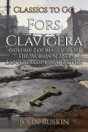
Fors Clavigera: Restored Classics to Go Edition

· Otbebookpublishing
Ebook
418
Pages
Eligible

About this ebook

In these impassioned letters and meditations, Ruskin moves from biting social satire to searching moral instruction, using cold mornings, newspaper clippings, household accounts, and biblical genealogy alike to expose the spiritual failures of modern life. He denounces fashionable charity, luxury built on labor, theatrical self-deception, and a London society he sees as corrupted by greed, religious falsehood, and neglect of the poor, insisting that repentance, prayer, fasting, and honest physical work are the only true responses to national collapse. At the same time, he reflects on his own wealth, sacrifice, and the uneasy cost of remaining faithful to his principles. Alongside this public indictment runs a sustained program of education and reform: children should learn craft, observation, handwriting, Greek letters, reading, and moral judgment together; reading itself should nourish the soul, not merely entertain it. He recommends Scott and Genesis as tools for shaping character and historical imagination, then extends that method into publishing plans, company rules, and practical bookkeeping. The letters also include fierce appeals to young women to reject vanity for Christian service, and grim public examples—from starvation to iconoclasm and spectacle—that sharpen his warning against a society losing both compassion and faith. This edition has been fully restored with modern typesetting, custom cover design.
In these impassioned letters and meditations, Ruskin moves from biting social satire to searching moral instruction, using cold mornings, newspaper clippings, household accounts, and biblical genealogy alike to expose the spiritual failures of modern life. He denounces fashionable charity, luxury...

Discover more

About the author

John Ruskin was born in London in 1819 and grew into one of the most influential and wide-ranging voices of the nineteenth century, a writer whose life moved between art criticism, social thought, teaching, and reform. Educated at Oxford and deeply shaped by travel in Europe, he first gained fame for his eloquent defense of painting and architecture, but his interests soon expanded far beyond aesthetics into questions of labor, education, morality, nature, and the responsibilities of modern society. Across a remarkable body of essays, lectures, and letters, he argued that beauty could not be separated from ethics, that the condition of workers mattered as much as the splendor of buildings, and that industrial progress without spiritual and social care was a hollow victory. His later writings, especially his sustained public addresses to readers, became increasingly personal and urgent, blending prophetic criticism with practical concern for everyday life. Ruskin's central themes—environmental responsibility, the dignity of work, the value of craftsmanship, and the moral cost of unchecked materialism—feel strikingly contemporary today, speaking to debates about inequality, sustainability, and the place of art in public life. Though sometimes severe in judgment, he remains compelling for the seriousness of his vision and the beauty of his prose, which can move from fierce indignation to lyrical wonder in a single page. For modern readers interested in art, social justice, ecology, or the history of ideas, Ruskin offers both a challenge and a reward: a reminder that culture is never separate from conscience, and that how we live shapes what we make.

John Ruskin was born in London in 1819 and grew into one of the most influential and wide-ranging voices of the nineteenth century, a writer whose life moved between art criticism, social thought, teaching, and reform. Educated at Oxford and deeply shaped by travel in Europe, he first gained fame...

Rate this ebook

Tell us what you think.

Reading information

Smartphones and tablets
Install the Google Play Books app for Android and iPad/iPhone. It syncs automatically with your account and allows you to read online or offline wherever you are.
Laptops and computers
You can listen to audiobooks purchased on Google Play using your computer's web browser.
eReaders and other devices
To read on e-ink devices like Kobo eReaders, you'll need to download a file and transfer it to your device. Follow the detailed Help Center instructions to transfer the files to supported eReaders.