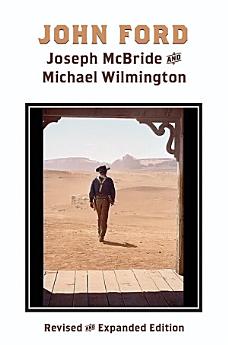
John Ford: Edition 2

·
· University Press of Kentucky
E-book
348
Pages
Outils

À propos de cet e-book

Orson Welles was once asked which directors he most admired. He replied: "The old masters. By which I mean John Ford, John Ford, and John Ford." A legend in his own time, John Ford (1894–1973) received a record four Academy Awards for best director, and two of his World War II documentaries won Oscars for the US Navy. He directed 136 films in a career that lasted from the early silent era through the late 1960s. Ford is celebrated throughout the world as the cinema's foremost chronicler of American history, the leading poet of the Western genre, and a wide-ranging filmmaker of profound emotional impact. His classic films—including Stagecoach (1939), The Grapes of Wrath (1940), How Green Was My Valley (1941), The Quiet Man (1952), The Searchers (1956), and The Man Who Shot Liberty Valance (1962)—remain widely popular, and he has been acknowledged as a major influence on filmmakers such as Jean Renoir, Ingmar Bergman, Akira Kurosawa, Howard Hawks, Frank Capra, Samuel Fuller, Elia Kazan, Sidney Lumet, Martin Scorsese, Steven Spielberg, and George Lucas.

In this groundbreaking critical study, Joseph McBride and Michael Wilmington provide an overview of Ford's career as well as in-depth analyses of key Ford films. Analyzing recurring Fordian themes and relating each film to his entire body of work, the authors insightfully explore the full richness of Ford's tragicomic vision of history. This new and revised version includes a study of the twenty-seven Ford silent films now known to survive in whole or in part (more than double the number available when the original edition was published); essays on three controversial aspects of Ford: his tragicomic sensibility, his views of race, and the influence of his Irish heritage; and an expanded version of McBride's interview with Ford on the last day of his career.
Orson Welles was once asked which directors he most admired. He replied: "The old masters. By which I mean John Ford, John Ford, and John Ford." A legend in his own time, John Ford (1894–1973) received a record four Academy Awards for best director, and two of his World War II documentaries won O...

En voir d'autres

À propos de l'auteur

Joseph McBride is the author of twenty-four books, including the biography Searching for John Ford (hailed as "definitive" by the New York Times and the Irish Times), biographies of Capra and Spielberg, three books on Welles, and critical studies of Ernst Lubitsch and Billy Wilder. A former film and television writer as well as a reporter, reviewer, and columnist for Daily Variety in Hollywood, McBride is a professor in the School of Cinema at San Francisco State University. Michael Wilmington (1946–2022) was a renowned film reviewer for the Chicago Tribune and other publications, including the Los Angeles Times, LA Weekly, L.A. Style, Movie City News, Sight & Sound, Film Comment, and Isthmus. While at the Tribune, Wilmington won two Peter Lisagor awards for arts criticism. The National Society of Film Critics, of which Wilmington was a longtime member, dedicated its 2022 awards to his memory. He was also a celebrated stage actor and teacher and a reviewer on cable television.
Joseph McBride is the author of twenty-four books, including the biography Searching for John Ford (hailed as "definitive" by the New York Times and the Irish Times), biographies of Capra and Spielberg, three books on Welles, and critical studies of Ernst Lubitsch and Billy Wilder. A former film ...

Donner une note à cet e-book

Dites-nous ce que vous en pensez.

Informations sur la lecture

Smartphones et tablettes
Installez l'application Google Play Livres pour Android et iPad ou iPhone. Elle se synchronise automatiquement avec votre compte et vous permet de lire des livres en ligne ou hors connexion, où que vous soyez.
Ordinateurs portables et de bureau
Vous pouvez écouter les livres audio achetés sur Google Play à l'aide du navigateur Web de votre ordinateur.
Liseuses et autres appareils
Pour lire sur des appareils e-Ink, comme les liseuses Kobo, vous devez télécharger un fichier et le transférer sur l'appareil en question. Suivez les instructions détaillées du Centre d'aide pour transférer les fichiers sur les liseuses compatibles.