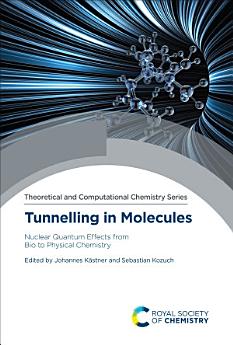
Tunnelling in Molecules: Nuclear Quantum Effects from Bio to Physical Chemistry

·
· Theoretical and Computational Chemistry Series Book 18 · Royal Society of Chemistry
Ebook
436
Pages
Tools

About this ebook

Quantum tunnelling is one of the strangest phenomena in chemistry, where we see the wave nature of atoms acting in “impossible” ways. By letting molecules pass through the kinetic barrier instead of over it, this effect can lead to chemical reactions even close to the absolute zero, to atypical spectroscopic observations, to bizarre selectivity, or to colossal isotopic effects. Quantum mechanical tunnelling observations might be infrequent in chemistry, but it permeates through all its disciplines producing remarkable chemical outcomes. For that reason, the 21st century has seen a great increase in theoretical and experimental findings involving molecular tunnelling effects, as well as in novel techniques that permit their accurate predictions and analysis.

Including experimental, computational and theoretical chapters, from the physical and organic to the biochemistry fields, from the applied to the academic arenas, this new book provides a broad and conceptual perspective on tunnelling reactions and how to study them. Quantum Tunnelling in Molecules is the obligatory stop for both the specialist and those new to this world.

Quantum tunnelling is one of the strangest phenomena in chemistry, where we see the wave nature of atoms acting in “impossible” ways. By letting molecules pass through the kinetic barrier instead of over it, this effect can lead to chemical reactions even close to the absolute zero, to atypical s...

Discover more

About the author

Sebastian Kozuch got his licentiate in chemistry from the University of Buenos Aires, and his Ph.D. at the Hebrew University of Jerusalem under the supervision of Sason Shaik. He did postdocs at the Weizmann Institute of Sciences with Jan Martin and at the University of North Texas with Weston T. Borden. Since 2014 he is a professor at the Ben-Gurion University of the Negev. His theoretical interests cross over three main fields: (1) Catalysis, kinetics, organometallics, and everything in between, from where he developed the “Energy Span Model”. (2) The chemical bond, especially the theory of hole interactions. (3) Quantum tunnelling, with a fascination for the chemistry of heavy atom tunnelling.

Johannes Kästner studied chemistry and got his doctorate in physics. After research stays at the Max Planck Institute for coal research with Walter Thiel and at Daresbury Laboratory, he became professor for computational chemistry at the University of Stuttgart, Germany. He developed methods for free-energy sampling, umbrella integration, and investigates biochemical processes by force field and QM/MM approaches. His main focus of research, however, is the calculation of tunnelling rate constants. He is the lead author of DL-FIND, a library to optimize molecular geometries and to calculate rate constants with transition state theory, the small-curvature tunnelling approximation and instanton theory. His developments broadened the scope of instanton theory to make it applicable to many chemical systems, so that it is nowadays used in diverse fields like biochemistry, catalysis, and astrochemistry.
Sebastian Kozuch got his licentiate in chemistry from the University of Buenos Aires, and his Ph.D. at the Hebrew University of Jerusalem under the supervision of Sason Shaik. He did postdocs at the Weizmann Institute of Sciences with Jan Martin and at the University of North Texas with Weston T....

Rate this ebook

Tell us what you think.

Reading information

Smartphones and tablets
Install the Google Play Books app for Android and iPad/iPhone. It syncs automatically with your account and allows you to read online or offline wherever you are.
Laptops and computers
You can listen to audiobooks purchased on Google Play using your computer's web browser.
eReaders and other devices
To read on e-ink devices like Kobo eReaders, you'll need to download a file and transfer it to your device. Follow the detailed Help Center instructions to transfer the files to supported eReaders.