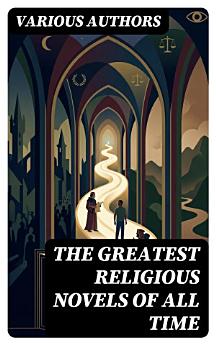
The Greatest Religious Novels of All Time: Enriched edition. Religious Fiction Collection: The Grand Inquisitor, Faust, The Holy War, Divine Comedy, Ben-Hur...
Johann Wolfgang von Goethe · Gustave Flaubert · Mark Twain · Henryk Sienkiewicz · Dante Alighieri · George MacDonald · Anatole France · Henry Van Dyke · Robert Hugh Benson · Arthur Christopher Benson · Leonid Andreyev · John Bunyan · Grace Livingston Hill · Voltaire · Paul Laurence Dunbar · John Milton · Charles M. Sheldon · Marie Corelli · John Henry Newman · James Joyce · G. K. Chesterton · Friedrich Nietzsche · Anton Chekhov · Leo Tolstoy · Fyodor Dostoevsky · Prentice Mulford
Nov 2023 · DigiCat
Ebook
8095
Pages
family_home
Eligible
info
About this ebook
The anthology titled 'The Greatest Religious Novels of All Time' embarks on an enlightening exploration of the spiritual and metaphysical, offering a mesmerizing traverse through literary history. This collection brings together a stunning diversity of narrative styles and deeply philosophical inquiries, ranging from profound theological musings to vibrant social commentaries, all framed around religious or existential themes. The works capture the essence of faith and doubt, morality and humanity, serving as both mirrors and maps for spiritual introspection. Certain narratives provide poignant tales of personal redemption while others engage with the divine in boldly unorthodox manners, illustrating the vast spectrum of how religion and spirituality can be approached in literature. The roster of contributing authors spans centuries and continents, each with distinct cultural backgrounds and ideological leanings that inject richness into this anthology. From Goethe and Flaubert of Europe's Enlightenment to Chekhov and Dostoevsky of Russia's intense philosophical tradition, and spanning fields as varied as the mysticism of Dante to the satirical sharpness of Voltaire, these authors collectively contribute to a mosaic of perspectives. Their works align with pivotal historical and cultural movements, reflecting the evolving dialogue between faith, reason, and artistic expression that defines the human experience. 'By engaging with 'The Greatest Religious Novels of All Time,' readers are invited into an intellectual pilgrimage—a nuanced and multi-perspective dialogue with some of history's most profound religious thinkers and storytellers. The anthology is not merely a collection, but an educational odyssey, offering a unique opportunity to witness the confluence of literary art, religiosity, and philosophical discourse. Ideal for both casual readers seeking inspiration and scholars studying the intersections of literature and theology, this collection provides illuminating insights into diverse spiritual landscapes, ensuring an enriching experience for all who venture into its pages. In this enriched edition, we have carefully created added value for your reading experience: - An Introduction draws the threads together, discussing why these diverse authors and texts belong in one collection. - Historical Context explores the cultural and intellectual currents that shaped these works, offering insight into the shared (or contrasting) eras that influenced each writer. - A combined Synopsis (Selection) briefly outlines the key plots or arguments of the included pieces, helping readers grasp the anthology's overall scope without giving away essential twists. - A collective Analysis highlights common themes, stylistic variations, and significant crossovers in tone and technique, tying together writers from different backgrounds. - Reflection questions encourage readers to compare the different voices and perspectives within the collection, fostering a richer understanding of the overarching conversation.
The anthology titled 'The Greatest Religious Novels of All Time' embarks on an enlightening exploration of the spiritual and metaphysical, offering a mesmerizing traverse through literary history. This collection brings together a stunning diversity of narrative styles and deeply philosophical in...
Discover more
About the author
Johann Wolfgang von Goethe (1749–1832) is regarded as one of the towering figures of German literature and Western thought. His versatile literary creation comprises poetic and dramatic works, memoirs, an autobiography, and various literary and scientific fragments that influenced a wide spectrum of disciplines. As a key figure of the Sturm und Drang literary movement, Goethe set a milestone in German literature with his novel 'The Sorrows of Young Werther' (1774), precipitating the Romantic literary movement. Goethe's magnum opus, 'Faust,' a dramatic poem that delves deeply into philosophy and human values, not only exemplified his own creative breadth but also reflected the complex intellectual discourse of his time. Goethe's literary style is marked by his profound humanism, a deep concern with personal freedom and individualism, and an enduring fascination with the natural and spiritual realms. While 'The Greatest Religious Novels of All Time' has been erroneously attributed or listed under Goethe by some sources, it is not a recognized work of Goethe. Instead, his major contributions, such as 'Wilhelm Meister's Apprenticeship' and 'Elective Affinities,' exhibit his talent for psychological insight and societal commentary. His literary legacy is so distinguished that the Goethe-Institut, a worldwide cultural institute, has been named in his honor to promote the study of the German language and the dissemination of international cultural cooperation.
Johann Wolfgang von Goethe (1749–1832) is regarded as one of the towering figures of German literature and Western thought. His versatile literary creation comprises poetic and dramatic works, memoirs, an autobiography, and various literary and scientific fragments that influenced a wide spectrum...
Rate this ebook
Tell us what you think.
Reading information
Smartphones and tablets
Install the Google Play Books app for Android and iPad/iPhone. It syncs automatically with your account and allows you to read online or offline wherever you are.
Laptops and computers
You can listen to audiobooks purchased on Google Play using your computer's web browser.
eReaders and other devices
To read on e-ink devices like Kobo eReaders, you'll need to download a file and transfer it to your device. Follow the detailed Help Center instructions to transfer the files to supported eReaders.