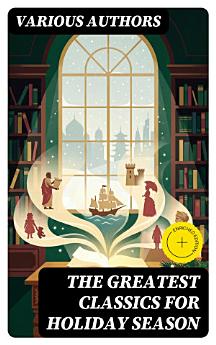
The Greatest Classics for Holiday Season
Johann Wolfgang von Goethe · Stendhal · Jules Verne · Gustave Flaubert · Lewis Carroll · Theodor Storm · Henrik Ibsen · Charles Dickens · Plato · Honoré de Balzac · Mark Twain · Harriet Beecher Stowe · Rabindranath Tagore · Fyodor Dostoyevsky · Walt Whitman · Niccolò Machiavelli · Oscar Wilde · Robert Louis Stevenson · James Fenimore Cooper · Edgar Allan Poe · William Shakespeare · Giovanni Boccaccio · Confucius · George MacDonald · Charlotte Brontë · Anne Brontë · Emily Brontë · Henry David Thoreau · Jack London · Henry James · Louisa May Alcott · Victor Hugo · Arthur Conan Doyle · Frances Hodgson Burnett · Joseph Conrad · Jane Austen · Herman Melville · George Eliot · Laurence Sterne · Thomas Hardy · Jonathan Swift · Edith Wharton · Benito Pérez Galdós · Daniel Defoe · Henry Fielding · Alexandre Dumas · Rudyard Kipling · William Dean Howells · Kalidasa · Kenneth Grahame · Marcel Proust · Washington Irving · Juan Valera · Willa Cather · Nathaniel Hawthorne · Homer · Gaston Leroux · Charles Baudelaire · William Makepeace Thackeray · Voltaire · Kate Chopin · Apuleius · John Milton · Charlotte Perkins Gilman · Frederick Douglass · Laozi · John Keats · James Joyce · Ann Ward Radcliffe · Kahlil Gibran · Kakuzo Okakura · Soseki Natsume · Princess Der Ling · L. Frank Baum · H. G. Wells · W. B. Yeats · J. M. Barrie · G. K. Chesterton · T. S. Eliot · L. M. Montgomery · C. S. Lewis · D. H. Lawrence · E. M. Forster · H. P. Lovecraft · F. Scott Fitzgerald · Marcus Aurelius · Friedrich Nietzsche · Lewis Wallace · Ivan Turgenev · Anton Chekhov · Leo Tolstoy · Nikolai Gogol · Sir Walter Scott · George Bernard Shaw · Miguel de Cervantes · Mary Shelley · Cao Xueqin · Emile Zola · Válmíki · Bankim Chandra Chatterjee · P. B. Shelley · Elizabeth von Arnim · Herman Hesse · Dante · Pedro Calderon de la Barca · Sun Tzu · Inazo Nitobé · Bram Stoke · George Weedon Grossmith · Willkie Collins
Nov 2022 · DigiCat
Ebook
47072
Pages
family_home
Eligible
info
About this ebook
The Greatest Classics for Holiday Season is a resplendent anthology that traverses an eclectic landscape of literary prowess, encompassing the monumental works of renowned authors across various eras and cultures. This compilation weaves together an array of styles — from the introspective poetry of Whitman to the mesmerizing narrative craft of Dickens and the philosophical musings of Plato. It presents a confluence of genres including Gothic, Romantic, and Modernist, offering readers an unparalleled exploration of human experience and artistic expression. Each selection, whether it be a surreal journey or a poignant societal critique, represents a jewel in the crown of classic literature, serving as both a reflection and a critique of the human condition. The anthology features illustrious voices from across the globe, representing pivotal movements such as Romanticism, Realism, and the Enlightenment. Figures like Goethe, Tagore, and Dostoyevsky collectively shape the collection's thematic core, enriched by the diverse cultural and historical contexts they bring from Germany, India, and Russia, respectively. The works also echo philosophical and reflective undertones from the East, with contributions by Confucius and Laozi, uniting diverse perspectives to create a harmonious dialogue and presenting a comprehensive vista of literary evolution. This holiday season, immerse yourself in the timeless wisdom and vivid narratives of the world's greatest literary minds with The Greatest Classics for Holiday Season. Whether for educational enrichment or leisurely reflection, this anthology invites readers to engage with its broad spectrum of insights and artistic mastery. It's not just a collection of stories, but a celebration of the rich tapestry of human thought and the beauty of narrative imagination, making it an essential addition to any literary enthusiast's bookshelf.
The Greatest Classics for Holiday Season is a resplendent anthology that traverses an eclectic landscape of literary prowess, encompassing the monumental works of renowned authors across various eras and cultures. This compilation weaves together an array of styles — from the introspective poetry...
Discover more
About the author
Johann Wolfgang von Goethe (1749–1832) stands as a towering figure in world literature. A versatile German writer, dramatist, and philosopher, Goethe's influence extends beyond literature into the philosophical and scientific domains. His literary style encompasses a rich array of forms, integrating Romanticism, Classicism, and Realism in a body of work marked by deep introspection, a love of nature, and an acute understanding of human passions and struggles. Perhaps best known for his two-part poetic drama, 'Faust,' Goethe's oeuvre also includes an astonishing variety of poetry, novels, and scientific treatises. His first novel, 'The Sorrows of Young Werther' (1774), was instrumental in developing the Sturm und Drang literary movement, capturing the emotional turmoil and intellectual ferment of the time. Goethe's 'Wilhelm Meister's Apprenticeship' is considered a prototypical bildungsroman, exploring the thematic tapestry of education and personal growth. Meanwhile, 'Elective Affinities' showcases Goethe's exploration of the complexities of human relationships through the metaphor of chemical reactions. His extensive travels through Italy led to the autobiographical work 'Italian Journey,' which offers insights into both the culture of the time and the author's own development. In Goethe's vast compilation, 'The Greatest Classics for Holiday Season' may include a selection of his writings that emphasize themes pertinent to reflection, festivity, and the human experience, encapsulating the profound wisdom and artistic beauty characteristic of his work. Goethe's literary legacy is preserved by the universality of his themes and the timeless nature of his prose and verse.
Johann Wolfgang von Goethe (1749–1832) stands as a towering figure in world literature. A versatile German writer, dramatist, and philosopher, Goethe's influence extends beyond literature into the philosophical and scientific domains. His literary style encompasses a rich array of forms, integrat...
Rate this ebook
Tell us what you think.
Reading information
Smartphones and tablets
Install the Google Play Books app for Android and iPad/iPhone. It syncs automatically with your account and allows you to read online or offline wherever you are.
Laptops and computers
You can listen to audiobooks purchased on Google Play using your computer's web browser.
eReaders and other devices
To read on e-ink devices like Kobo eReaders, you'll need to download a file and transfer it to your device. Follow the detailed Help Center instructions to transfer the files to supported eReaders.