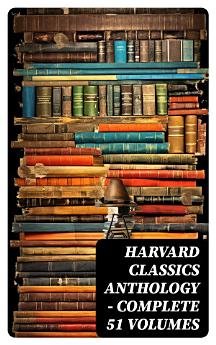
Harvard Classics Anthology - Complete 51 Volumes: The Greatest Works of World Literature - Dr. Eliot's Five Foot Shelf
Johann Wolfgang von Goethe · Gotthold Ephraim Lessing · Thomas Carlyle · Plato · René Descartes · Immanuel Kant · Charles Darwin · Martin Luther · Robert Louis Stevenson · William Shakespeare · Dante Alighieri · Euripides · Percy Bysshe Shelley · Charles Lamb · Henry David Thoreau · Samuel Johnson · John Stuart Mill · David Hume · Joseph Addison · John Locke · John Fletcher · Francis Beaumont · Leigh Hunt · Epictetus · Thomas De Quincey · Samuel Taylor Coleridge · Jonathan Swift · Christopher Marlowe · Jacob Grimm · Wilhelm Grimm · William Hazlitt · Marcus Tullius Cicero · Daniel Defoe · Aesop · Richard Henry Dana · John Dryden · Philip Massinger · Pedro Calderón de la Barca · John Ruskin · Oliver Wendell Holmes · Ernest Renan · Robert Burns · David Garrick · Ralph Waldo Emerson · John Webster · Izaak Walton · John Bunyan · James Russell Lowell · Charles Augustin Sainte-Beuve · Homer · Edmund Burke · Plutarch · Molière · Aeschylus · Michael Faraday · Sophocles · William Makepeace Thackeray · Benjamin Franklin · Pierre Corneille · Jean Racine · Voltaire · Robert Browning · Oliver Goldsmith · Thomas Dekker · John Milton · Aristophanes · Blaise Pascal · Virgil · Richard Brinsley Sheridan · Simon Newcomb · William Penn · Walter Bigges · Philip Sidney · Herodotus · Walter Raleigh · Francis Bacon · Giuseppe Mazzini · Francis Pretty · George Berkeley · Thomas Hobbes · Adam Smith · Alessandro Manzoni · Abraham Cowley · Michel de Montaigne · Ben Jonson · John Woolman · Benvenuto Cellini · Sydney Smith · Jean Froissart · William Henry Harrison · William Harvey · Marcus Aurelius · Hans Christian Andersen · Thomas Malory · George Gordon Byron · Thomas à Kempis · Richard Steele · Thomas Browne · Archibald Geikie · Thomas Babington Macaulay · Tacitus · William Roper · Hippocrates · Miguel de Cervantes · Thomas More · Friedrich von Schiller · Philip Nichols · Louis Pasteur · Joseph Lister · Jean Jacques Rousseau · Pliny the Younger · Edgar Alan Poe · Saint Augustine · Hermann Ludwig Ferdinand von Helmholtz · Francis Drake · Edward Haies · Niccolo Machiavelli · Ambroise Paré · William A. Neilson
Nov 2023 · DigiCat
Ebook
21084
Pages
family_home
Eligible
info
About this ebook
The 'Harvard Classics Anthology - Complete 51 Volumes' is a monumental collection that beckons readers into the depth and breadth of centuries' worth of wisdom and creative expression. This compendium embraces a variety of themes, ranging from the philosophical inquiries of existence and morality to the dazzling flights of literary imagination. Through essays, plays, poetry, and philosophical discourses, this anthology showcases a marvelous spectrum of human thought and artistry. Standout pieces across these volumes, while not individually attributed here, paint an intricate tapestry of intellectual triumphs echoing the historical and cultural zeitgeist across ages. The anthology is enriched by the contributions of a stellar ensemble of legendary thinkers and literary giants, including luminaries such as Shakespeare, Descartes, Darwin, and more. Across its extensive lineage from classical antiquity to the Enlightenment and beyond, this collection serves as a bridge connecting readers to diverse cultural and historical currents. As a curated selection aligning with key literary and philosophical movements, it reveals the profound insights these authors imbue into themes such as human nature, society, and the cosmos, fostering a deeper appreciation of the interconnectedness of their ideas across history. This anthology offers a unique opportunity to journey through the annals of human thought and creativity, presenting a formidable educational resource for those eager to explore multiple perspectives and styles unified in one voluminous work. Each volume serves as a dialogue between the minds of the past and present, fostering reflection and growth. Dive into this rich collection to uncover the compelling narratives and timeless truths that continue to shape our world and broaden your understanding of humanity's literary heritage.
The 'Harvard Classics Anthology - Complete 51 Volumes' is a monumental collection that beckons readers into the depth and breadth of centuries' worth of wisdom and creative expression. This compendium embraces a variety of themes, ranging from the philosophical inquiries of existence and morality...
About the author
Johann Wolfgang von Goethe (1749–1832) stands as a towering figure in world literature, his works forming a bridge between the Enlightenment and Romanticism in European culture. A versatile genius, Goethe was a poet, novelist, dramatist, and natural philosopher. His most celebrated novel, 'Faust,' explores the depths of human striving and despair, becoming a staple in the Western literary canon. Goethe's impact on various domains of art and thought is reflected broadly in the Harvard Classics Anthology, a comprehensive collection that aims to gather the most significant writings of civilization, among which Goethe's contributions shine prominently. His mastery of both verse and prose, along with a keen insight into human nature and society, have cemented his reputation as a seminal figure in the arts and humanities. The breadth of his literary style spans from the classical simplicity of his early 'Sturm und Drang' works to the complexity and richness of his later literature, which embodies a blend of Romantic ideals with a deep appreciation for the classical tradition. The Harvard Classics Anthology, a testament to the enduring legacy of human thought and creativity, showcases Goethe's works not simply as cultural artifacts, but as living dialogues with the human condition and the search for meaning that define his enduring relevance.
Johann Wolfgang von Goethe (1749–1832) stands as a towering figure in world literature, his works forming a bridge between the Enlightenment and Romanticism in European culture. A versatile genius, Goethe was a poet, novelist, dramatist, and natural philosopher. His most celebrated novel, 'Faust,...
Rate this ebook
Tell us what you think.
Reading information
Smartphones and tablets
Install the Google Play Books app for Android and iPad/iPhone. It syncs automatically with your account and allows you to read online or offline wherever you are.
Laptops and computers
You can listen to audiobooks purchased on Google Play using your computer's web browser.
eReaders and other devices
To read on e-ink devices like Kobo eReaders, you'll need to download a file and transfer it to your device. Follow the detailed Help Center instructions to transfer the files to supported eReaders.