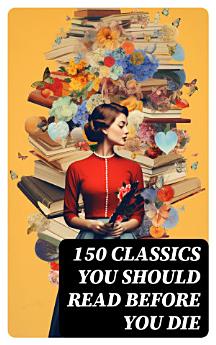
150 Classics You Should Read Before You Die: Romeo and Juliet, Emma, Vanity Fair, Middlemarch, Tom Sawyer, Faust, Notre Dame de Paris, Dubliners, Odyssey
Johann Wolfgang von Goethe · Stendhal · Jules Verne · Gustave Flaubert · Lewis Carroll · Charles Dickens · Plato · Honoré de Balzac · Mark Twain · Harriet Beecher Stowe · Walt Whitman · Oscar Wilde · Robert Louis Stevenson · James Fenimore Cooper · Edgar Allan Poe · William Shakespeare · George MacDonald · Bram Stoker · Charlotte Brontë · Anne Brontë · Emily Brontë · Henry David Thoreau · Jack London · Henry James · Louisa May Alcott · Victor Hugo · Arthur Conan Doyle · Frances Hodgson Burnett · Joseph Conrad · Jane Austen · Herman Melville · George Eliot · Laurence Sterne · Thomas Hardy · Jonathan Swift · Edith Wharton · Daniel Defoe · Henry Fielding · Kenneth Grahame · Marcel Proust · Willa Cather · Nathaniel Hawthorne · Homer · Gaston Leroux · William Makepeace Thackeray · Kate Chopin · Apuleius · John Milton · Frederick Douglass · John Keats · James Joyce · Ann Ward Radcliffe · Kahlil Gibran · H. G. Wells · W. B. Yeats · J. M. Barrie · G. K. Chesterton · T. S. Eliot · L. M. Montgomery · C. S. Lewis · D. H. Lawrence · E. M. Forster · H. P. Lovecraft · Marcus Aurelius · Friedrich Nietzsche · Lewis Wallace · Sir Walter Scott · George Bernard Shaw · Mary Shelley · P. B. Shelley · Elizabeth von Arnim · Herman Hesse · George Weedon Grossmith · Willkie Collins
Nov 2023 · DigiCat
Ebook
47068
Pages
family_home
Eligible
info
About this ebook
150 Classics You Should Read Before You Die is an expansive anthology that encapsulates the rich tapestry of literary history, drawing from a remarkable array of styles and genres. Spanning works from ancient philosophy to modernist poetry, this curated collection captures the essence of human experience, thought, and creativity across centuries. Without attributing specific pieces to individual authors, the anthology places a spotlight on timeless themes such as love, morality, adventure, and social justice, each brought to life through the unique lens of the authors' diverse cultural and historical contexts. The anthology features a magnificent confluence of voices, from the philosophical musings of Plato and Marcus Aurelius to the vivid narratives of Dickens and Twain. It includes innovators of literary movements such as Romanticism and Transcendentalism, exploring societal lanes carved by pioneers like Austen and Hugo. These legendary authors breathe life into an era of shifting paradigms and evolving artistic expression, creating a dialogue that crosses borders and epochs, collectively shaping a robust understanding of our shared literary heritage and human condition. Encouraging both newcomers and seasoned readers to delve into its pages, this anthology offers an exceptional journey through a multiplicity of worldviews and storytelling techniques, reinforcing the notion that literature is a mirror reflecting the facets of humanity. Its educational breadth and profound insights offer more than entertainment; they foster a reflective dialogue between readers and the legacies of the greatest literary minds. Whether for personal enrichment or academic pursuit, 150 Classics You Should Read Before You Die is an indispensable treasure for any literary collection.
150 Classics You Should Read Before You Die is an expansive anthology that encapsulates the rich tapestry of literary history, drawing from a remarkable array of styles and genres. Spanning works from ancient philosophy to modernist poetry, this curated collection captures the essence of human ex...
Discover more
About the author
Johann Wolfgang von Goethe (1749–1832), a towering figure in German literature, was a polymath whose impact extended beyond his native land to shape Western literature and thought. Renowned for his literary versatility, Goethe delved into poetry, drama, literature, theology, humanism, and science. He is best known for 'Faust,' an epic drama exploring themes of ambition, desire, and redemption, which has been hailed as one of the greatest works of Western literature. His novel 'The Sorrows of Young Werther' sparked the Sturm und Drang literary movement and inspired a generation with its Romantic emphasis on individual emotion and rebellion against social conventions. Goethe's body of work encompasses a wide spectrum of genres and reflects his keen intellect and profound understanding of human nature. His writing style blended elements of Enlightenment thinking with Romantic sensibility, neoclassical aesthetics, and an enduring interest in the natural world. Goethe's profound influence on the literary world is underscored by his masterful use of language, his philosophical insights, and his enduring contributions to a range of intellectual disciplines. While '150 Classics You Should Read Before You Die' is not specifically attributed to Goethe, his canonical status ensures his works are a staple in such collections, affirming his role as a cornerstone of classical and modern humanist thought.
Johann Wolfgang von Goethe (1749–1832), a towering figure in German literature, was a polymath whose impact extended beyond his native land to shape Western literature and thought. Renowned for his literary versatility, Goethe delved into poetry, drama, literature, theology, humanism, and science...
Rate this ebook
Tell us what you think.
Reading information
Smartphones and tablets
Install the Google Play Books app for Android and iPad/iPhone. It syncs automatically with your account and allows you to read online or offline wherever you are.
Laptops and computers
You can listen to audiobooks purchased on Google Play using your computer's web browser.
eReaders and other devices
To read on e-ink devices like Kobo eReaders, you'll need to download a file and transfer it to your device. Follow the detailed Help Center instructions to transfer the files to supported eReaders.