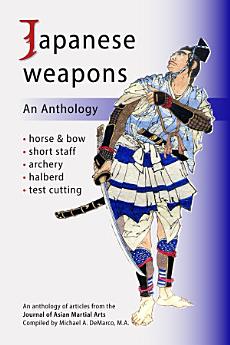
Japanese Weapons - An Anthology
Um þessa rafbók
Three chapters place a focus on archery and the related formalities of ritual and practice. Two of these discuss the uniqueness of Japanese kyudo—the Way of the Bow. As kyudo is a martial art practiced as a do or “spiritual way,” the authors emphasize the meditative aspects. Dr. Hesselink’s chapter differs in that his work details the art of archery performed at full-gallop on horseback.
In the first chapter, Dr. Jones discusses his personal experience in Japan while testing for blackbelt in jodo—the Way of the short staff. In another chapter, Rick Polland points out aspects of solo short staff practice and how it also applies with an opponent.
Ellis Amdur’s chapter dives into great detail on the history and evolution of the naganita—a bladed polearm ustilized over many centuries in Japanese warfare and later also as a do practice with individual spiritual cultivation as its primary objective. The beauty of naganita blades are no less intrincally interesting than the highly respected making and use of Japanese swords.
Tameshigiri—test cutting—is the topic of the final chapter. Utilizing the Swiss Visual Human technology, Dr. Ward analized sixteen major cuts that were often used by the samurai against their opponents. In the past, test cutters would use human cadavers to see exactly how sword cuts affected particular body parts, e.g., neck, torso, wrist, etc. Each area attacked could be rated according to the difficulty of each cut. How does the composition of the body (thickness of bone, muscle tissue, cartledge, etc.) affect the skillfull execution of the blade? The questions and answers that arise while reading this chapter provide great insight into the use of all bladed weapons.
Although the chapters in this anthology discuss archery, the short staff, mounted archery, the naginata and test cutting, there is a common theme: the importance of these to Japanese martial traditions.
Uppgötvaðu meira
Um höfundinn
AUTHORS: David Jones, Ph.D., Ellis Amdur, M.A., Reinier H. Hesselink, Ph.D., Rick Polland, B.A., Deborah Klens-Bigman, Ph.D., Edwin Symmes, B.A., and Peter J. Ward, Ph.D.