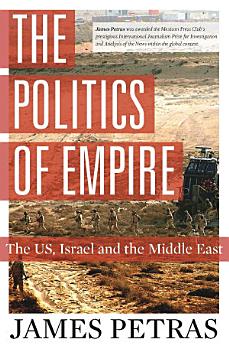
The Politics of Empire: The US, Israel and the Middle East
Oct 2014 · SCB Distributors
Ebook
196
Pages
Tools
info
family_home
Eligible
info
About this ebook
This book provides a unique conception of US empire
building, linking overseas expansion with:
1) the growth of a police state and declining living
standards;
2) advanced technologically driven global spying on
adversaries and allies with declining economic
competitiveness and military defeats;
3) large scale, long term commitments of economic and
military resources to wars in the Middle East to the
detriment of major corporate interests, but for the benefit
of a pariah state, Israel; and
4) the power of a foreign state (Israel) over US policy via
its domestic pro-Zionist power configuration.
The interplay of these four specific features of US empire
building has no past or present precedent among imperial
states. Because of Israeli-Zionist influence on US imperial
policy, the main targets and objectives of imperial wars are
located in the Middle East. The objectives of Israeli and Zionist-
influenced US policy in the Middle East is to enhance Israeli
regional power and the dispossession of the Palestinian
people. The trillion dollar cost of US wars for Israel, however,
has alienated the vast majority of US society and driven a wedge
between the political elite backing new wars for Israel, and the
public prioritizing of domestic economic welfare. This study
highlights how the domestic foundations of empire building
have deteriorated and forced the imperial presidency to modify
its approach, seeking diplomatic negotiations over new military
interventions, specifically in the cases of Syria and Iran.
Imperial politics is viewed as a multi-sided power struggle
between military and economic elites, Israel and the Zionist
power configuration, overseas resistance movements and
nationalist regimes, and the US public. The resolution of this
power struggle is more than an academic question; it will
determine whether the US will become a full blown police state,
ruled by the pawns of a racist-colonial state engaged in endless
wars or return to its roots as an independent democratic
republic “free of foreign entanglements”.
This book provides a unique conception of US empire
building, linking overseas expansion with:
1) the growth of a police state and declining living
standards;
2) advanced technologically driven global spying on
adversaries and allies with declining economic
competitiveness and military def...
Discover more
About the author
James Petras is a Bartle Professor (Emeritus) of Sociology at Binghamton University, New York. He is the author of 64 books published in 29 languages, and over 560 articles in professional journals, including the American Sociological Review, British Journal of Sociology, Social Research, Journal of Contemporary Asia, and Journal of Peasant Studies. He has published over 2000 articles in nonprofessional journals.
James Petras is a Bartle Professor (Emeritus) of Sociology at Binghamton University, New York. He is the author of 64 books published in 29 languages, and over 560 articles in professional journals, including the American Sociological Review, British Journal of Sociology, Social Research, Journal...
Rate this ebook
Tell us what you think.
Reading information
Smartphones and tablets
Install the Google Play Books app for Android and iPad/iPhone. It syncs automatically with your account and allows you to read online or offline wherever you are.
Laptops and computers
You can listen to audiobooks purchased on Google Play using your computer's web browser.
eReaders and other devices
To read on e-ink devices like Kobo eReaders, you'll need to download a file and transfer it to your device. Follow the detailed Help Center instructions to transfer the files to supported eReaders.