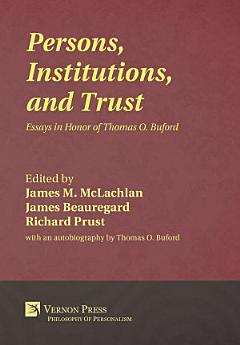
Persons, Institutions, and Trust: Essays in Honor of Thomas O. Buford

· · · · · · · · ·
· Vernon Press
Ebook
250
Pages
Eligible

About this ebook

The papers presented in this volume honor Thomas O. Buford. Buford is Professor Emeritus in Philosophy at Furman University where he taught for more than forty years. Several of the papers in this volume are from former students. But Professor Buford is also a pre-eminent voice of fourth generation Personalism, and Boston Personalism in particular. Personalism is a school of philosophical and theological thought which holds that the ideas of "person" and "personality" are indispensable to an adequate understanding of all metaphysical and epistemological problems, as well as are keys to an adequate theory of ethical and political human interaction. Most personalists assert that personality is an irreducible fact found in all existence, as well as in all interpretation of the meaning of existence and the truth about experience. Anything that seems to exist impersonally, such as inanimate matter, nevertheless can exist and have meaning only as related to some personal being. The Boston Personalist tradition was inaugurated by Borden Parker Bowne and continued by Edgar S. Brightman, Peter Bertocci, John Lavely, Carol Robb, and Martin Luther King, Jr.
The papers presented in this volume honor Thomas O. Buford. Buford is Professor Emeritus in Philosophy at Furman University where he taught for more than forty years. Several of the papers in this volume are from former students. But Professor Buford is also a pre-eminent voice of fourth generati...

Discover more

About the author

James McLachlan is Professor of Philosophy and Religion at Western Carolina University. He the author of several books and articles on Personalism and the problem of evil including: "The Desire to be God: Freedom and the Other in Sartre and Berdyaev"; and most recently, the articles: "Mormonism and the Problem of Evil"; "Mystic Terror and Metaphysical Rebels: Active Evil and Active Love in Schelling and Dostoevsky"; "Satan: Romantic Hero or Just Another Asshole: The Desire to be God, The Devil, and the Demonic"; "Hell Is Others and Paradise Is Others: Hell in the Existential Paris of Sartre and Berdyaev"; and, "The il y a and the Ungrund: Levinas and the Russian Existentialists Berdyaev and Shestov." He is co-director of the Levinas Summer Seminar and co-founder and co-organizer of the Personalist Seminar. He has known Thomas Buford since 1990. Tom has mentored him since then and helped him discover he was a personalist. James Beauregard is a Lecturer and Faculty in the Psy.D. program at Rivier University, Nashua, New Hampshire, where he teaches Neuropsychology, Biological Bases of Behavior, Educational Neuroscience, and Aging. His research interests are in the fields of neuroethics and personalist philosophy including the intersection of these two areas as they impact our understandings of personhood. He is a member of the British Personalist Forum and the International Neuroethics Society. Richard C. Prust lives in Chapel Hill, NC, where he works on a book on personal identity in moral and legal reasoning and teaches part-time in Duke's continuing education program. He is active in the International Forum on Persons. Before retiring from full-time teaching, he taught philosophy at St. Andrews University in North Carolina. His book, Wholeness: the Character Logic of Christian Belief, is published by Rodopi Press.
James McLachlan is Professor of Philosophy and Religion at Western Carolina University. He the author of several books and articles on Personalism and the problem of evil including: "The Desire to be God: Freedom and the Other in Sartre and Berdyaev"; and most recently, the articles: "Mormonism a...

Rate this ebook

Tell us what you think.

Reading information

Smartphones and tablets
Install the Google Play Books app for Android and iPad/iPhone. It syncs automatically with your account and allows you to read online or offline wherever you are.
Laptops and computers
You can listen to audiobooks purchased on Google Play using your computer's web browser.
eReaders and other devices
To read on e-ink devices like Kobo eReaders, you'll need to download a file and transfer it to your device. Follow the detailed Help Center instructions to transfer the files to supported eReaders.