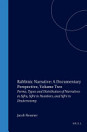
Rabbinic Narrative: A Documentary Perspective, Volume Four: The Precedent and the Parable in Diachronic View
Nov 2021 · BRILL
Ebook
292
Pages
Tools
info
About this ebook
Each Rabbinic document, from the Mishnah through the Bavli, defines itself by a unique combination of indicative traits of rhetoric, topic, and particular logic that governs its coherent discourse. But narratives in the same canonical compilations do not conform to the documentary indicators that govern in these compilations, respectively. They form an anomaly for the documentary reading of the Rabbinic canon of the formative age.
To remove that anomaly, this project classifies the types and forms of narratives and shows that particular documents exhibit distinctive preferences among those types. This detailed, systematic classification of Rabbinic narrative supplies these facts concerning the classification of narratives and their regularities: [1] what are the types and forms of narrative in a given document? [2] how are these distinctive types and forms of narrative distributed across the canonical documents of the formative age, the first six centuries C.E.?
The answers for the documentary preferences are in Volumes One through Three, for the Mishnah-Tosefta, the Tannaite Midrash-compilations, and Rabbah-Midrash-compilations, respectively. Volume Four then sets forth the documentary history of each of the types of Rabbinic narrative, including the authentic narrative, the ma'aseh and the mashal. How the traits of the several types of narratives shift as the respective types move from document to document is spelled out in complete detail. This project opens an entirely new road toward the documentary analysis of Rabbinic narrative. It fills out an important chapter in the documentary hypothesis of the Rabbinic canon in the formative age.
To remove that anomaly, this project classifies the types and forms of narratives and shows that particular documents exhibit distinctive preferences among those types. This detailed, systematic classification of Rabbinic narrative supplies these facts concerning the classification of narratives and their regularities: [1] what are the types and forms of narrative in a given document? [2] how are these distinctive types and forms of narrative distributed across the canonical documents of the formative age, the first six centuries C.E.?
The answers for the documentary preferences are in Volumes One through Three, for the Mishnah-Tosefta, the Tannaite Midrash-compilations, and Rabbah-Midrash-compilations, respectively. Volume Four then sets forth the documentary history of each of the types of Rabbinic narrative, including the authentic narrative, the ma'aseh and the mashal. How the traits of the several types of narratives shift as the respective types move from document to document is spelled out in complete detail. This project opens an entirely new road toward the documentary analysis of Rabbinic narrative. It fills out an important chapter in the documentary hypothesis of the Rabbinic canon in the formative age.
Each Rabbinic document, from the Mishnah through the Bavli, defines itself by a unique combination of indicative traits of rhetoric, topic, and particular logic that governs its coherent discourse. But narratives in the same canonical compilations do not conform to the documentary indicators that...
Discover more
About the author
Jacob Neusner is Research Professor of Religion and Theology at Bard College, Annandale-on-Hudson, New York, a Life Member of Clare Hall, Cambridge University, and a Member of the Institute for Advanced Study in Princeton NJ.
Jacob Neusner is Research Professor of Religion and Theology at Bard College, Annandale-on-Hudson, New York, a Life Member of Clare Hall, Cambridge University, and a Member of the Institute for Advanced Study in Princeton NJ.
Rate this ebook
Tell us what you think.
Reading information
Smartphones and tablets
Install the Google Play Books app for Android and iPad/iPhone. It syncs automatically with your account and allows you to read online or offline wherever you are.
Laptops and computers
You can listen to audiobooks purchased on Google Play using your computer's web browser.
eReaders and other devices
To read on e-ink devices like Kobo eReaders, you'll need to download a file and transfer it to your device. Follow the detailed Help Center instructions to transfer the files to supported eReaders.