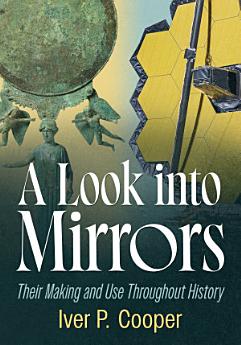
A Look into Mirrors: Their Making and Use Throughout History
Feb 2026 · McFarland
Ebook
251
Pages
Tools
info
family_home
Eligible
info
About this ebook
In the distant past, a human being noticed their reflection in a body of water and that the reflection was of their own body. It was, perhaps, love at first sight.
Over the course of several millennia, humans learned how to make that reflection portable, first by polishing stone and metal, then by bonding a metal to the back of a clear glass or plastic. As the reflections became clearer and brighter, mirrors were applied to more than self-inspection: for extended vision, via periscopes, telescopes, microscopes, and cameras; for communication, via heliographs, photophones, and the mirror galvanometers of undersea telegraph cables; for amusement, via kaleidoscopes and stage illusions; for energy, via solar furnaces and sunlight-propelled spacecraft; and for other purposes, via many additional ingenious devices. This book presents the story of the construction and use of mirrors for work and play.
In the distant past, a human being noticed their reflection in a body of water and that the reflection was of their own body. It was, perhaps, love at first sight.
Over the course of several millennia, humans learned how to make that reflection portable, first by polishing stone and metal, then b...
Discover more
About the author
Iver P. Cooper is a retired patent attorney and is an independent researcher in the history of science and technology. He lives in Arlington, Virginia.
Iver P. Cooper is a retired patent attorney and is an independent researcher in the history of science and technology. He lives in Arlington, Virginia.
Rate this ebook
Tell us what you think.
Reading information
Smartphones and tablets
Install the Google Play Books app for Android and iPad/iPhone. It syncs automatically with your account and allows you to read online or offline wherever you are.
Laptops and computers
You can listen to audiobooks purchased on Google Play using your computer's web browser.
eReaders and other devices
To read on e-ink devices like Kobo eReaders, you'll need to download a file and transfer it to your device. Follow the detailed Help Center instructions to transfer the files to supported eReaders.