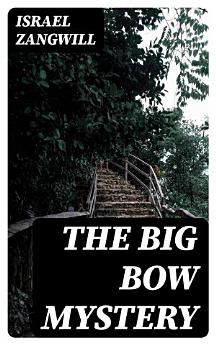
The Big Bow Mystery
Israel Zangwill
Sep 2022 · DigiCat
Ebook
109
Pages
family_home
Eligible
info
About this ebook
In Israel Zangwill's 1891 novel, "The Big Bow Mystery," readers are drawn into a meticulously crafted whodunit that defies conventional detective narratives. Set in the backdrop of London's East End, the story intricately weaves elements of social commentary with a compelling mystery. Zangwill employs a satirical literary style, engaging readers with sharp wit and vibrant characterizations, particularly through his exploration of class tensions and the complexities of urban life. The novel not only entertains but also critiques the societal norms of its time, making it a significant contribution to the genre of detective fiction in the Victorian era. Israel Zangwill, a prominent figure in the early 20th-century literary landscape, was deeply influenced by his Jewish heritage and the socio-political environment of turn-of-the-century Britain. Born in 1864 in London, Zangwill experienced firsthand the precarious realities of life in the immigrant communities. His diverse background and keen observations equipped him with a unique perspective that permeates "The Big Bow Mystery," showcasing the often-overlooked intersections between mystery, identity, and society. For readers who appreciate thought-provoking mysteries that engage with broader societal themes, "The Big Bow Mystery" is an essential addition to their library. Zangwill's ability to blend humor, intrigue, and social critique ensures that this novel remains not just a thrilling read, but also a poignant reflection on humanity and the societal challenges of its time.
In Israel Zangwill's 1891 novel, "The Big Bow Mystery," readers are drawn into a meticulously crafted whodunit that defies conventional detective narratives. Set in the backdrop of London's East End, the story intricately weaves elements of social commentary with a compelling mystery. Zangwill em...
Discover more
About the author
Israel Zangwill (1864–1926) was a British author and playwright, celebrated for his contributions to literature during the Victorian and Edwardian eras. Zangwill's work often grappled with complex issues of identity, Jewish life, and social justice, themes reflective of his own Jewish heritage and the socio-political milieu of his time. His literary style was marked by a keen wit and a penchant for both social critique and psychological insight, garnering him considerable acclaim during his lifetime. One of Zangwill's most enduring works is 'The Big Bow Mystery' (1892), a novel notable for being one of the first locked-room mysteries in the detective fiction genre. In this seminal work, Zangwill masterfully weaves a tale of intrigue and suspense, setting the standard for many mystery novels to come. The book is applauded not only for its compelling plot but also for its innovative use of the detective story to explore deeper societal issues. Beyond 'The Big Bow Mystery,' Zangwill's extensive oeuvre includes titles such as 'Children of the Ghetto' (1892), 'Dreamers of the Ghetto' (1898), and 'The Melting Pot' (1908), the latter of which popularized the term 'melting pot' to describe America's diverse immigrant population integrating into a single culture. Zangwill's literary legacy continues to be studied for its unique blend of entertainment, intellectualism, and advocacy for cultural understanding and ethnic harmony.
Israel Zangwill (1864–1926) was a British author and playwright, celebrated for his contributions to literature during the Victorian and Edwardian eras. Zangwill's work often grappled with complex issues of identity, Jewish life, and social justice, themes reflective of his own Jewish heritage an...
Rate this ebook
Tell us what you think.
Reading information
Smartphones and tablets
Install the Google Play Books app for Android and iPad/iPhone. It syncs automatically with your account and allows you to read online or offline wherever you are.
Laptops and computers
You can listen to audiobooks purchased on Google Play using your computer's web browser.
eReaders and other devices
To read on e-ink devices like Kobo eReaders, you'll need to download a file and transfer it to your device. Follow the detailed Help Center instructions to transfer the files to supported eReaders.