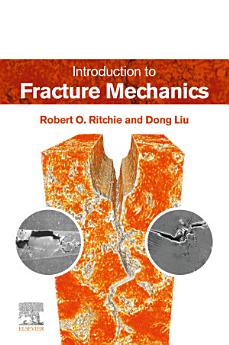
Introduction to Fracture Mechanics
мај 2021. · Elsevier
Е-књига
168
Страница
family_home
Испуњава услове
info
О овој е-књизи
Introduction to Fracture Mechanics presents an introduction to the origins, formulation and application of fracture mechanics for the design, safe operation and life prediction in structural materials and components. The book introduces and informs the reader on how fracture mechanics works and how it is so different from other forms of analysis that are used to characterize mechanical properties. Chapters cover foundational topics and the use of linear-elastic fracture mechanics, involving both K-based characterizing parameter and G-based energy approaches, and how to characterize the fracture toughness of materials under plane-strain and non plane-strain conditions using the notion of crack-resistance or R-curves. Other sections cover far more complex nonlinear-elastic fracture mechanics based on the use of the J-integral and the crack-tip opening displacement. These topics largely involve continuum mechanics descriptions of crack initiation, slow crack growth, eventual instability by overload fracture, and subcritical cracking. - Presents how, for a given material, a fracture toughness value can be measured on a small laboratory sample and then used directly to predict the failure (by fracture, fatigue, creep, etc.) of a much larger structure in service - Covers the rudiments of fracture mechanics from the perspective of the philosophy underlying the few principles and the many assumptions that form the basis of the discipline - Provides readers with a "working knowledge" of fracture mechanics, describing its potency for damage-tolerant design, for preventing failures through appropriate life-prediction strategies, and for quantitative failure analysis (fracture diagnostics)
Introduction to Fracture Mechanics presents an introduction to the origins, formulation and application of fracture mechanics for the design, safe operation and life prediction in structural materials and components. The book introduces and informs the reader on how fracture mechanics works and h...
Откријте још
О аутору
Prof. Robert O. Ritchie is the H.T. & Jessie Chua Distinguished Professor of Engineering in the Departments of Materials Science & Engineering and Mechanical Engineering at the University of California in Berkeley; he is also Senior Materials Scientist at the Lawrence Berkeley National Laboratory. He received M.A., Ph.D. and Sc.D. degrees in materials science all from Cambridge University. He is known for his research into the mechanics and mechanisms of fracture and fatigue of a broad range of engineering and biological materials. He is a foreign member of the Royal Society and a fellow of the Royal Academy of Engineering, a member of the U.S. National Academy of Engineering, and a foreign member of the Russian Academy of Sciences and the Royal Swedish Academy of Engineering Sciences.Dr. Dong Liu is a Lecturer at the University of Bristol and she is the head of Experimental Mechanics of Advanced Materials (EMAM) Group. Her expertise lies in the multiple length-scale damage and fracture of nuclear and aerospace materials, not only in laboratory environments but also in their actual service conditions. Dr. Liu joined the University of Bristol as Lecturer in July 2018 from Oxford University (2015-2018) where she held an independent 1851 Exhibition Royal Commission Fellowship (Brunel) and an EPSRC postdoctoral research fellowship. Dr. Liu was also awarded a Junior Research Fellowship at Mansfield College (2016-2018) while at the University of Oxford.
Prof. Robert O. Ritchie is the H.T. & Jessie Chua Distinguished Professor of Engineering in the Departments of Materials Science & Engineering and Mechanical Engineering at the University of California in Berkeley; he is also Senior Materials Scientist at the Lawrence Berkeley National Laboratory...
Оцените ову е-књигу
Јавите нам своје мишљење.
Информације о читању
Паметни телефони и таблети
Инсталирајте апликацију Google Play књиге за Android и iPad/iPhone. Аутоматски се синхронизује са налогом и омогућава вам да читате онлајн и офлајн где год да се налазите.
Лаптопови и рачунари
Можете да слушате аудио-књиге купљене на Google Play-у помоћу веб-прегледача на рачунару.
Е-читачи и други уређаји
Да бисте читали на уређајима које користе е-мастило, као што су Kobo е-читачи, треба да преузмете фајл и пренесете га на уређај. Пратите детаљна упутства из центра за помоћ да бисте пренели фајлове у подржане е-читаче.