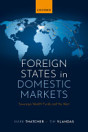
Internationalisation and Economic Institutions:: Comparing the European Experience
2007年7月 · OUP Oxford
电子书
336
页
family_home
符合条件
info
关于此电子书
This book examines when, how and why internationalisation affects national economic institutions. It confronts questions at the heart of debates in political economy and comparative politics: What does internationalisation of markets mean? Who are its carriers in domestic arenas? Through which mechanisms does it affect decisions about national institutional reform? What are institutional outcomes in the face of internationalisation? The book responds to its questions by looking at key economic institutions in five strategic sectors: securities trading, telecommunications, electricity, airlines and postal services. It compares across four countries that represent different 'varieties of capitalism', namely Britain, France, Germany and Italy, over the period between 1965 and 2005. Thus it combines cross-national, historical and cross-sectoral comparisons. The author distinguishes technological and economic forms of internationalisation from policy forms, notably decisions in powerful overseas nations and supranational regulation. He argues that, contrary to expectations, the first was met with institutional inertia. In contrast, policy forms of internationalisation, namely reforms in the US and European Union regulation, played significant roles in undermining long-standing national institutions. The book explores the mechanisms whereby policy forms of internationalisation were influential by looking at the strategies, coalitions and resources of key actors in national arenas. It also shows that institutional outcomes were surprising: all four countries, albeit through different routes, adopted increasingly similar reforms of economic institutions- privatisation, the ending of monopolies and delegation to independent regulatory agencies. The book rejects the view that technological and economic forms of internationalisation drive institutional change. It suggests that policy forms of internationalisation are more important because they become part of domestic decision making and aid the reform of well-established national institutions.
This book examines when, how and why internationalisation affects national economic institutions. It confronts questions at the heart of debates in political economy and comparative politics: What does internationalisation of markets mean? Who are its carriers in domestic arenas? Through which me...
探索更多
作者简介
Mark Thatcher is Reader in Public Administration and Public Policy, Department of Government, London School of Economics and a member of the Centre for the Analysis of Risk and Regulation (CARR), LSE. His research lies in the field of comparative public policy and regulation in Europe. His interests lie in the way that institutions are designed and created, and then the effects of those institutions on the relationships between politics and markets. He has worked on the regulation of telecommunications and other utilities in Britain, France, Germany and Italy, and at the EU level. His is currently studying the regulatory reform in Western Europe and the effects of independent regulatory agencies.
Mark Thatcher is Reader in Public Administration and Public Policy, Department of Government, London School of Economics and a member of the Centre for the Analysis of Risk and Regulation (CARR), LSE. His research lies in the field of comparative public policy and regulation in Europe. His intere...
为此电子书评分
欢迎向我们提供反馈意见。
如何阅读
智能手机和平板电脑
笔记本电脑和台式机
您可以使用计算机的网络浏览器聆听您在 Google Play 购买的有声读物。
电子阅读器和其他设备
如果要在 Kobo 电子阅读器等电子墨水屏设备上阅读,您需要下载一个文件,并将其传输到相应设备上。若要将文件传输到受支持的电子阅读器上,请按帮助中心内的详细说明操作。