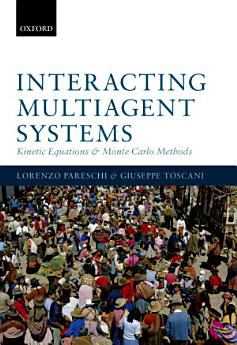
Interacting Multiagent Systems: Kinetic equations and Monte Carlo methods
નવે 2013 · OUP Oxford
ઇ-પુસ્તક
392
પેજ
family_home
પાત્ર
info
આ ઇ-પુસ્તક વિશે
The description of emerging collective phenomena and self-organization in systems composed of large numbers of individuals has gained increasing interest from various research communities in biology, ecology, robotics and control theory, as well as sociology and economics. Applied mathematics is concerned with the construction, analysis and interpretation of mathematical models that can shed light on significant problems of the natural sciences as well as our daily lives. To this set of problems belongs the description of the collective behaviours of complex systems composed by a large enough number of individuals. Examples of such systems are interacting agents in a financial market, potential voters during political elections, or groups of animals with a tendency to flock or herd. Among other possible approaches, this book provides a step-by-step introduction to the mathematical modelling based on a mesoscopic description and the construction of efficient simulation algorithms by Monte Carlo methods. The arguments of the book cover various applications, from the analysis of wealth distributions, the formation of opinions and choices, the price dynamics in a financial market, to the description of cell mutations and the swarming of birds and fishes. By means of methods inspired by the kinetic theory of rarefied gases, a robust approach to mathematical modelling and numerical simulation of multi-agent systems is presented in detail. The content is a useful reference text for applied mathematicians, physicists, biologists and economists who want to learn about modelling and approximation of such challenging phenomena.
The description of emerging collective phenomena and self-organization in systems composed of large numbers of individuals has gained increasing interest from various research communities in biology, ecology, robotics and control theory, as well as sociology and economics. Applied mathematics is ...
વધુ શોધો
લેખક વિશે
Lorenzo Pareschi is full professor of numerical analysis at the University of Ferrara. He holds a PhD in mathematics from Bologna University (1996). He is a leading expert in computational methods and modelling for nonlinear partial differential equations. His research interests include kinetic equations, hyperbolic conservation laws and relaxation systems, stiff systems and Monte Carlo methods. He has co-written three books and more than one hundred peer-reviewed articles. He serves as an associate editor for the SIAM Journal of Scientific Computing (SISC), Multiscale Modelling and Simulation (MMS), Kinetic and Related Models (KRM) and Communications in Mathematical Sciences (CMS). He held visiting professor positions at the University of Wisconsin, Madison (USA), the Georgia Institute of Technology, Atlanta, (USA), the University of Orleans (France) and the University of Toulouse (France). Giuseppe Toscani is full professor of mathematical physics at the University of Pavia. His recent scientific interests are concerned with theoretical and numerical problems connected to the kinetic theory of rarefied gases, asymptotic behaviour of nonlinear diffusion equations by entropy methods, and kinetic modelling of socio-economic multi-agents systems. He has authored around 200 papers, written both individually or jointly with national and international experts, as well as two monographs on the mathematical aspects of Boltzmann equation and of Enskog equation in kinetic theory of rarefied gases. He held visiting professor positions at the Georgia Institute of Technology, Atlanta, (USA), and at the Universities of Paris VI, Paris Dauphine, Nice and Toulouse (France).
Lorenzo Pareschi is full professor of numerical analysis at the University of Ferrara. He holds a PhD in mathematics from Bologna University (1996). He is a leading expert in computational methods and modelling for nonlinear partial differential equations. His research interests include kinetic e...
આ ઇ-પુસ્તકને રેટિંગ આપો
તમે શું વિચારો છો અમને જણાવો.
માહિતી વાંચવી
સ્માર્ટફોન અને ટૅબ્લેટ
Android અને iPad/iPhone માટે Google Play Books ઍપ ઇન્સ્ટૉલ કરો. તે તમારા એકાઉન્ટ સાથે ઑટોમૅટિક રીતે સિંક થાય છે અને તમને જ્યાં પણ હો ત્યાં તમને ઑનલાઇન અથવા ઑફલાઇન વાંચવાની મંજૂરી આપે છે.
લૅપટૉપ અને કમ્પ્યુટર
Google Play પર ખરીદેલ ઑડિઓબુકને તમે તમારા કમ્પ્યુટરના વેબ બ્રાઉઝરનો ઉપયોગ કરીને સાંભળી શકો છો.
eReaders અને અન્ય ડિવાઇસ
Kobo ઇ-રીડર જેવા ઇ-ઇંક ડિવાઇસ પર વાંચવા માટે, તમારે ફાઇલને ડાઉનલોડ કરીને તમારા ડિવાઇસ પર ટ્રાન્સફર કરવાની જરૂર પડશે. સપોર્ટેડ ઇ-રીડર પર ફાઇલો ટ્રાન્સ્ફર કરવા માટે સહાયતા કેન્દ્રની વિગતવાર સૂચનાઓ અનુસરો.


