About this ebook
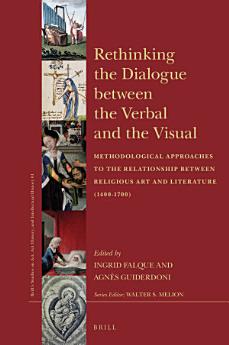
Intermediality, figurability, iconotext, visual exegesis: these are some of the many new ways in which the relationship between text and image has been explored in recent decades. Scholars have benefited from theoretical work in the fields of anthropology, psychoanalysis, and semiotics, alongside more traditional fields such as literature, art history and cultural history. Focusing on religious texts and images between 1400 and 1700, the essays gathered in this volume contribute to these developments by grounding their case studies in methodology. In considering various relations between the visual and the verbal, the editors have adopted the broadest position possible, emphasizing the phenomenological point of view from which the objects under discussion are examined.
Contributors to this volume: Ralph Dekoninck, Anna Dlabačová, Grégory Ems, Ingrid Falque, Agnès Guiderdoni, Walter S. Melion, Kees Schepers, Paul J. Smith, and Elliott D. Wise.
Contributors to this volume: Ralph Dekoninck, Anna Dlabačová, Grégory Ems, Ingrid Falque, Agnès Guiderdoni, Walter S. Melion, Kees Schepers, Paul J. Smith, and Elliott D. Wise.
Intermediality, figurability, iconotext, visual exegesis: these are some of the many new ways in which the relationship between text and image has been explored in recent decades. Scholars have benefited from theoretical work in the fields of anthropology, psychoanalysis, and semiotics, alongside...
Discover more
About the author
Ingrid Falque is Research Associate with the Fonds National de la Recherche Scientifique (Belgium) and Professor of History of Medieval Art at the UCLouvain. She is also co-director of the Centre for Early Modern Cultural Analysis (GEMCA, UCLouvain) and member of the Royal Academy of Archaeology of Belgium. Her research focuses on the history, theories and practices of images, the relationships between art and spirituality and the attitudes towards devotional imagery, and visual experience in Northern Europe during the late Middle Ages. She published several articles and edited volumes on these topics. Her book Devotional Portraiture and Spiritual Experience in Early Netherlandish Painting has been published by Brill in 2019.
Agnès Guiderdoni is Senior Research Associate with the Fonds National de la Recherche Scientifique (Belgium) and Professor of Early Modern Literature at the UCLouvain, where she is the co-director of the Centre for Early Modern Cultural Analysis (GEMCA). Originally a specialist of seventeenth-century French literature, she more particularly studies emblematic literature and the field of figurative representations (imago figurata). She has published many articles on these topics, as well as on theoretical aspects of the relations between text and image. Among her publications: “Louis Marin’s Theories of Representation between Text and Image: From Visuality to Figurability”, in N. Saint et A. Stafford (eds), Modern French Visual Theory, 2013; in 2017, a co-edited special issue of the journal La Part de l’Œil on Force de figures. Le travail de la figurabilité entre texte et image ; “The Theory of Figurative Language in Maximilian Van Der Sandt’s Writings”, in K. Enenkel, W. Melion and W. de Boer, Jesuit Image Theory, 1540–1740, 2016 ; and a volume in 2019 on Maximilianus Sandaeus, un jésuite entre mystique et symbolique, also co-edited.
Agnès Guiderdoni is Senior Research Associate with the Fonds National de la Recherche Scientifique (Belgium) and Professor of Early Modern Literature at the UCLouvain, where she is the co-director of the Centre for Early Modern Cultural Analysis (GEMCA). Originally a specialist of seventeenth-century French literature, she more particularly studies emblematic literature and the field of figurative representations (imago figurata). She has published many articles on these topics, as well as on theoretical aspects of the relations between text and image. Among her publications: “Louis Marin’s Theories of Representation between Text and Image: From Visuality to Figurability”, in N. Saint et A. Stafford (eds), Modern French Visual Theory, 2013; in 2017, a co-edited special issue of the journal La Part de l’Œil on Force de figures. Le travail de la figurabilité entre texte et image ; “The Theory of Figurative Language in Maximilian Van Der Sandt’s Writings”, in K. Enenkel, W. Melion and W. de Boer, Jesuit Image Theory, 1540–1740, 2016 ; and a volume in 2019 on Maximilianus Sandaeus, un jésuite entre mystique et symbolique, also co-edited.
Ingrid Falque is Research Associate with the Fonds National de la Recherche Scientifique (Belgium) and Professor of History of Medieval Art at the UCLouvain. She is also co-director of the Centre for Early Modern Cultural Analysis (GEMCA, UCLouvain) and member of the Royal Academy of Archaeology ...
Rate this ebook
Tell us what you think.
Reading information
Smartphones and tablets
Install the Google Play Books app for Android and iPad/iPhone. It syncs automatically with your account and allows you to read online or offline wherever you are.
Laptops and computers
You can listen to audiobooks purchased on Google Play using your computer's web browser.
eReaders and other devices
To read on e-ink devices like Kobo eReaders, you'll need to download a file and transfer it to your device. Follow the detailed Help Center instructions to transfer the files to supported eReaders.