About this ebook
A formal wine and spirits certification demands two seemingly contradictory feats at the exact same moment: memorizing an encyclopedic mountain of technical theory—hundreds of appellations, micro-climates, soil classifications, pruning styles, and complex wine laws—while developing a calibrated, clinical palate that can evaluate and describe an unlabelled glass with surgical precision under strict exam conditions.
Most candidates attack this mountain the only way modern academia taught them: with hundreds of digital flashcards, dry regional lists, and exhausted brute-force memorization. And most candidates watch that fragile data slide right off when testing pressure hits.
That is not a discipline failure, an age problem, or an inadequate palate. It is a fundamental sensory-method failure.
Your brain was never evolved to retain disconnected two-dimensional lists. It was engineered to remember tastes, aromas, landscapes, geography, and shared tables—and it holds sensory impressions for a lifetime.
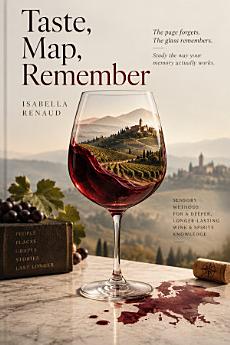
Taste, Map, Remember: A Sensory Study System for Passing WSET, Sommelier, and Spirits Exams Without Brute-Force Memorization is the definitive, palate-first sommelier study guide, WSET tasting and theory manual, and sensory memory system written in the vivid, literate voice of someone who fell in love with the glass first. Bypassing flat flashcard cramming, this guide transforms the human senses into your primary retention engine—delivering regional mental maps, deductive tasting architectures, and systematic sensory-anchoring frameworks on how to pass WSET Levels 2, 3, and Diploma, master the Court of Master Sommeliers (CMS) exams, and blind-taste with calm deductive confidence.
Whether you are a hospitality professional working late floor shifts, a retail wine buyer, or an ambitious enthusiast taking your first serious sommelier exam, this field manual gives you an unshakeable, elegant system to lock in the theory, calibrate your palate, and pass with distinction.
Inside This Sensory-Driven Beverage Certification Study System:
• The Neuroscience of Sensory Anchoring: How to permanently bind dry, abstract viticultural theory—diurnal temperature swings, slate soils, botrytis, and oak maturation—directly to specific olfactory and structural markers in the glass, so every sip becomes a retrieval hook for theory. • Spatial Regional Mental Maps: How to mentally organize the sprawling geography of Bordeaux, Burgundy, the Rhône, Piedmont, and the New World into intuitive, walkable mental landscapes that make appellation hierarchies and Cru classifications effortless to navigate. • Calibrating the Deductive Tasting Engine: A clinical, low-panic framework for blind tasting that replaces wild guessing with systematic, step-by-step deductive deduction: evaluating structural pillars (acidity, tannin, alcohol, sweetness, body) to narrow down climate, grape variety, region, and vintage with repeatable accuracy. • Translating Raw Sensation into Exam-Ready Vocabulary: How to bridge the gap between what you intuitively taste and the precise, standardized lexicon required by formal evaluation rubrics (such as the WSET Systematic Approach to Tasting / SAT). • Taming the Regulatory Firehose: Master European wine laws (AOP/DOCG/Prädikat), aging minimums, and labeling regulations by understanding the underlying historical and commercial logic rather than forcing arbitrary legal rote memorization. • Sustainable Tasting & Budget Logistics: How to build high-yield tasting flights on a real-world budget, form low-drama peer tasting groups, and preserve sample bottles effectively across weeks of study. • The Working Sommelier’s Study Rhythm: A realistic, modular study cadence designed around the grueling hours, late nights, and physical demands of restaurant and retail hospitality schedules. • Conquering Exam Day & Blind-Tasting Panic: Tactical mental routines to silence testing anxiety, reset olfactory fatigue during multi-glass flights, pace your written theory responses, and enter the examination room calm, sharp, and centered.
Who This Book Is For:
This manual is engineered specifically for candidates preparing for WSET (Levels 2, 3, or Diploma), Court of Master Sommeliers (Introductory & Certified), Society of Wine Educators (CSW/CSS), and French/Italian Wine Scholar certifications, as well as bartenders, beverage managers, wine buyers, and serious private collectors seeking a sophisticated, sensory-first study architecture.
You did not get into wine to memorize spreadsheets and recite legal statutes under fluorescent lights. You fell in love with what happens when soil, sun, vine, and human craft meet in a glass. When you let your palate lead the way, the theory stops feeling like homework and becomes the natural language of what you already love.
Taste, Map, Remember turns dry regional trivia into lasting sensory understanding. Included within the book are references to printable regional mapping worksheets, blind-tasting deductive decision grids, vocabulary calibration cheat sheets, and companion digital tasting-flight logs optimized for mobile and tablet study.
Trust your palate. Map the geography. Raise your glass, take your seat, and remember.
Note: This educational study guide provides sensory learning frameworks, deductive tasting methodologies, and cognitive study techniques for informational and personal enrichment purposes. It is an independent publication and is not affiliated with, endorsed by, or sponsored by the Wine & Spirit Education Trust (WSET), the Court of Master Sommeliers (CMS), the Society of Wine Educators, or the Wine Scholar Guild. Examination rubrics, curriculum requirements, and tasting formats are established exclusively by the respective credentialing bodies; candidates should always cross-reference official syllabus materials and candidate handbooks.