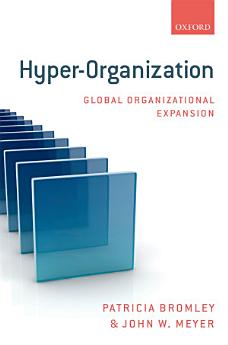
Hyper-Organization: Global Organizational Expansion
nov 2015 · Oxford University Press
Libro electrónico
272
Páginas
family_home
Apto
info
Acerca de este libro electrónico
Hyper-Organization offers an institutional explanation for the expansion of formal organization in the contemporary era-in numbers, internal complexity, social domains, and national contexts. Much expansion is hard to justify in terms of technical production or political power, it lies in areas such as protecting the environment, promoting marginalized groups, or behaving with transparency. The authors argue that expansion is supported by widespread cultural rationalization characterized by scientism, rights and empowerment discourses, and an explosion of education. These cultural changes are transmitted through legal, accounting, and professionalization principles, driving the creation of new organizations and the elaboration of existing ones. The resulting organizations are constructed to be proper social actors, as much as functionally effective entities. They are painted as autonomous and integrated but depend heavily on external definitions to sustain this depiction. So expansion creates organizations that are, whatever their actual effectiveness, structurally arational. This book advances theories of social organization in three main ways. First, by giving an account of the expansive rise of 'organization' rooted in rapid worldwide cultural rationalization. Second, explaining the construction of contemporary organizations as purposive actors, rather than passive bureaucracies or loose associations. Third, showing how the expanded actorhood of the contemporary organization, and the associated interpenetration with the environment, dialectically generate structures far removed from instrumental rationality.
Hyper-Organization offers an institutional explanation for the expansion of formal organization in the contemporary era-in numbers, internal complexity, social domains, and national contexts. Much expansion is hard to justify in terms of technical production or political power, it lies in areas s...
Descubrir más
Acerca del autor
Patricia Bromley is an Assistant Professor of Education at Stanford University. Her work focuses on the rise and globalization of a culture emphasizing rational, scientific thinking and expansive forms of rights. She draws mainly on two settings - education systems and organizations - to show how the institutionalization of these new cultural emphases transforms societies worldwide. She received a doctoral degree from Stanford University's School of Education also studies changes to civic education curricula in countries around the world. John W. Meyer is Professor of Sociology (and, by courtesy, Education), emeritus, at Stanford. He has contributed to organizational theory, comparative education, and the sociology of education, developing sociological institutional theory. Since the 1970s, he has studied the impact of global society on national states and societies In 2003 he completed a collaborative study of worldwide science and its national effects. A more recent collaborative project is on the impact of globalization on organizational structures. He now studies the world human rights regime, world curricula in mass and higher education, and the worldwide expansion of formal organization. He is a member of the National Academy of Education, has honorary doctorates from the Stockholm School of Economics and the Universities of Bielefeld and Lucerne, and received the American Sociological Association's section awards for lifetime contributions to the sociology of education, and to the study of globalization.
Patricia Bromley is an Assistant Professor of Education at Stanford University. Her work focuses on the rise and globalization of a culture emphasizing rational, scientific thinking and expansive forms of rights. She draws mainly on two settings - education systems and organizations - to show how...
Califica este libro electrónico
Cuéntanos lo que piensas.
Información de lectura
Smartphones y tablets
Instala la app de Google Play Libros para Android y iPad/iPhone. Como se sincroniza de manera automática con tu cuenta, te permite leer en línea o sin conexión en cualquier lugar.
Laptops y computadoras
Para escuchar audiolibros adquiridos en Google Play, usa el navegador web de tu computadora.
Lectores electrónicos y otros dispositivos
Para leer en dispositivos de tinta electrónica, como los lectores de libros electrónicos Kobo, deberás descargar un archivo y transferirlo a tu dispositivo. Sigue las instrucciones detalladas que aparecen en el Centro de ayuda para transferir los archivos a lectores de libros electrónicos compatibles.