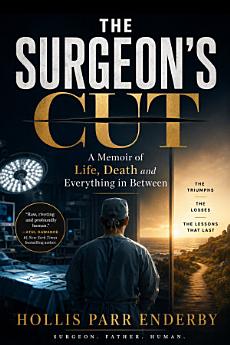
The Surgeon's Cut: A Memoir of Life, Death and Everything in Between
About this ebook
You would think the hardest part is the cutting.
People always ask that, when they find out what I do. At parties, at school gates, on aeroplanes when the passenger next to me spots the faded callus on my index finger from holding a needle driver. Isn’t it terrifying? they say. To open someone?
And I tell them no. Not really.
The cutting is the easiest part. The skin knows what to do. It parts along the steel like a zipper, and beneath that, the fat, the fascia, the muscle – they all have their own language of separation. A good scalpel is an honest thing. It does not lie. It does not hesitate. It only divides what was already two.
No. The hardest part is the silence.
Not the silence of the operating theatre – though that exists too, that particular hush when the anaesthetist says blood pressure is falling and everyone stops breathing for two seconds. I mean the other silence. The one that comes after you have closed. After you have washed your hands for the tenth time and pulled off your gloves and walked out into the corridor and realised that somewhere in that room, a person is alive because of what you did – or dead because of what you failed to see.
That silence follows me home.
It sits on the edge of the bed at 2am. It watches me pour a glass of water I won’t drink. It has a face, that silence, and the face changes depending on the case. Some nights it is a sixteen-year-old boy with a stab wound who laughed on the table while we poured four units of blood into him. Am I dying? he asked. Not tonight, I said. And he didn’t. But the silence asks: what about tomorrow?
Other nights the face is older. A woman with a belly full of cancer we didn’t catch soon enough. Her daughter held my hand in the relatives’ room and said you did everything and I said we did and we both knew that everything was not enough.
I have been a surgeon for twenty years. That is roughly seven thousand three hundred days. In that time I have made more than eight thousand incisions – give or take. I have held a human heart in my bare hand (once, briefly, during a trauma thoracotomy, and it was smaller and heavier than I expected). I have sewn a child’s liver back together. I have amputated a leg that belonged to a man who wept because he was grateful.
This book is not a textbook. It will not teach you how to operate. It will not give you a neat list of Things I Learned or Five Secrets of a Good Surgeon. I do not have five secrets. I have one: you are never as good as your best case, and never as bad as your worst. Everything else is in between.
The in-between is where we live.
The in-between is the three o’clock phone call from the emergency department. The in-between is the cup of tea you microwave three times and forget to drink. The in-between is the junior doctor who cries in the store cupboard and the consultant who pretends not to notice because he remembers doing the same thing in 1992.
I am writing this because the silence needs a voice. Not to explain surgery – God knows we explain enough. But to explain what it feels like to hold a life in your hands and then go home and make toast. To explain why some deaths follow you for years and others vanish by morning. To explain that surgeons are not gods. We are not heroes. We are not butchers.
We are just people who learned how to cut, and then spent the rest of our lives learning when not to.
So let me begin the only way I know how: with a patient who should have died, a mistake I almost made, and a scar that taught me everything.
Turn the page if you want. Or don’t. The story will wait.
It is very good at waiting.
— Hollis Parr Enderby
London / Glasgow / somewhere on call
Discover more
About the author
Hollis Parr Enderby grew up in a small town in the north of England, the daughter of a factory worker and a school secretary. She was the first person in her family to go to university. She did not plan to become a surgeon. She wanted to be a veterinarian, but she fainted the first time she saw a dog with a broken leg, so she chose humans instead. She has never fainted in an operating theatre, though she has come close twice.
She trained at hospitals across the United Kingdom, from Glasgow to Brighton, and has worked in the health service for more than twenty years. She is a consultant surgeon specialising in general and emergency surgery. She lives in a city she will not name, with a garden she rarely has time to tend and a cat who does not miss her when she is gone.
Her patients call her by her first name. Her colleagues call her when things go wrong. Her mother still asks when she is going to get a proper job.
This is her first book. She wrote it because the silence after a bad case needed a voice, and because she promised a patient once that she would tell the truth. The truth is messy. The truth is sad. The truth is also, sometimes, unexpectedly funny. She hopes you found all three in these pages.
She is not on any social media. She does not have a website. If you want to thank her or tell her she got something wrong, you can leave a note at the hospital reception desk. She will find it eventually. She always does.