About this ebook
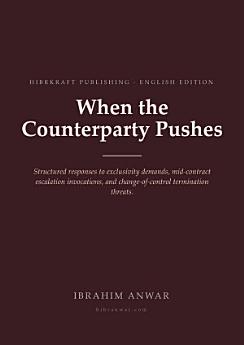
A six-question diagnostic intake routes the reader to the right framework based on which trigger has fired.
Exclusivity Opportunity Cost Model. Run when a counterparty proposes binding exclusivity. Computes the value of exclusivity against the foregone optionality and produces a structured counter-position. Two worked examples: a consumer goods producer fielding a distributor's exclusivity request, and a fabrication shop fielding a single-customer exclusivity demand.
Two-Track Escalation Response. Run when a vendor invokes a price-escalation clause mid-contract. Reconstructs the contractual basis, models the cost-pass-through capacity, and produces a defensible counter-offer. Two worked examples: a food production operator responding to a packaging supplier's escalation, and a B2B industrial equipment distributor in East Java responding to a category-wide escalation invocation.
Concern vs. Mechanism Analysis. Run when a key partner attempts to insert a change-of-control termination clause. Distinguishes the legitimate concern from the disproportionate mechanism and produces a counter-clause that preserves the relationship. Two worked examples: a logistics operator handling a customer's change-of-control demand, and a technology reseller handling a vendor's symmetrical demand.
Each tool carries a self-scoring rubric, a quick decision tree, and tier adaptations for single-owner shops, mid-tier businesses, and pre-IPO operations. The response plan at the back sequences the three frameworks across the first 48 hours, the first week, and the first month after a trigger fires.
This companion draws on operator experience running businesses in Indonesia. Examples, currency, and operational texture reflect that origin. The frameworks carry across to small and mid-sized businesses in other emerging markets and many developed-market SME settings.
What this companion does NOT do
Replace Contract Negotiation Tactics (Operator Playbooks 13).
Substitute for the weekly-rhythm or quarterly-review companions.
Who This Is For
Operators facing a specific contract trigger right now.
Owners with concentrated counterparty exposure who need structured pre-call analysis.
Mid-tier directors who need documented response procedures before any major contract crisis lands.
Topics and Keywords contract crisis response, exclusivity opportunity cost, escalation clause invocation, change of control termination, scenario-triggered contract decisions, counter-clause negotiation, SME contracts under pressure
Discover more
About the author
Ibrahim Anwar, known as Hibranwar. ORCID 0009-0006-0425-4923.