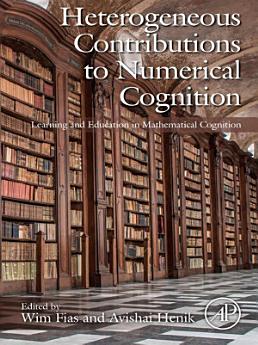
Heterogeneous Contributions to Numerical Cognition: Learning and Education in Mathematical Cognition

·
· Academic Press
E-book
422
Pages
Éligible

À propos de cet e-book

Arithmetic disability stems from deficits in neurodevelopment, with great individual differences in development or function of an individual at neuroanatomical, neuropsychological, behavioral, and interactional levels. Heterogeneous Contributions to Numerical Cognition: Learning and Education in Mathematical Cognition examines research in mathematical education methods and their neurodevelopmental basis, focusing on the underlying neurodevelopmental features that must be taken into account when teaching and learning mathematics. Cognitive domains and functions such as executive functions, memory, attention, and language contribute to numerical cognition and are essential for its proper development. These lines of research and thinking in neuroscience are discussed in this book to further the understanding of the neurodevelopmental and cognitive basis of more complex forms of mathematics – and how to best teach them. By unravelling the basic building blocks of numerical thinking and the developmental basis of human capacity for arithmetic, this book and the discussions within are important for the achievement of a comprehensive understanding of numerical cognition, its brain basis, development, breakdown in brain-injured individuals, and failures to master mathematical skills. - A novel innovative reference on the emerging field of numerical cognition and neurodevelopment underlying mathematical education - Includes an overview of the multiple disciplines that comprise numerical cognition written by world-leading researchers in the numerical cognition and neurodevelopment fields - Features an innovative organization with each section providing a general overview, developmental research, neurocognitive mechanisms, and discussion about relevant studies
Arithmetic disability stems from deficits in neurodevelopment, with great individual differences in development or function of an individual at neuroanatomical, neuropsychological, behavioral, and interactional levels. Heterogeneous Contributions to Numerical Cognition: Learning and Education in ...

En voir d'autres

À propos de l'auteur

Dr. Fias is a Professor of Experimental Psychology at Ghent University. He is currently editor-in-chief of the Journal of Numerical Cognition and has been consulting editor for Journal of Experimental Psychology: Learning Memory and Cognition and was an editorial board member of the journal Cognition. He serves regularly as an ad hoc reviewer for all major journals in the domain of Cognitive Psychology and Cognitive Neuroscience. Dr. Fias has over 100 publications on the topics of numerical cognition, working memory and cognitive control. His research uses behavioral and neuroimaging techniques in a complementary way.

Dr. Avishai Henik is a Professor of Psychology at Ben-Gurion University of the Negev. He holds a consulting editorial position with several journals (e.g., Psychonomic Bulletin and Review, Journal of Experimental Psychology: General) and serves regularly as an ad-hoc reviewer for various journals in the field and for granting agencies. Dr. Henik has over 300 publications of which most are in peer-reviewed journals. He has edited or co-edited three books in the area of numerical cognition. A leader in the field, he was awarded a prestigious European Research Council (ERC) Advanced Researcher grant to continue his cutting-edge research on the contribution of non-countable dimensions to the development and understanding of numerical cognition.
Dr. Fias is a Professor of Experimental Psychology at Ghent University. He is currently editor-in-chief of the Journal of Numerical Cognition and has been consulting editor for Journal of Experimental Psychology: Learning Memory and Cognition and was an editorial board member of the journal Cogni...

Donner une note à cet e-book

Dites-nous ce que vous en pensez.

Informations sur la lecture

Smartphones et tablettes
Installez l'application Google Play Livres pour Android et iPad ou iPhone. Elle se synchronise automatiquement avec votre compte et vous permet de lire des livres en ligne ou hors connexion, où que vous soyez.
Ordinateurs portables et de bureau
Vous pouvez écouter les livres audio achetés sur Google Play à l'aide du navigateur Web de votre ordinateur.
Liseuses et autres appareils
Pour lire sur des appareils e-Ink, comme les liseuses Kobo, vous devez télécharger un fichier et le transférer sur l'appareil en question. Suivez les instructions détaillées du Centre d'aide pour transférer les fichiers sur les liseuses compatibles.