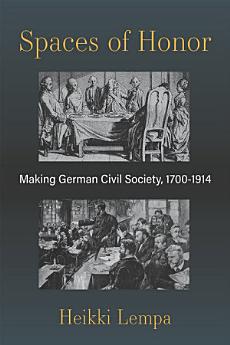
Spaces of Honor: Making German Civil Society, 1700-1914

· University of Michigan Press
Ebook
256
Pages
Tools
Eligible

About this ebook

The common understanding is that honor belongs to a bygone era, whereas civil society belongs to the future and modern society. Heikki Lempa argues that honor was not gone or even in decline between 1700 and 1914, and that civil society was not new but had long roots that stretched into the Middle Ages. In fact, what is peculiar for this era in Germany were the deep connections between practices of honor and civil society. This study focuses on collective actions of honor and finds them, in a series of case studies, at such communal spaces as schools, theaters, lunch and dinner tables, spas, workers’ strikes, and demonstrations. It is in these collective actions that we see civil society in making.

The Spaces of Honor sees civil society not primarily as an idea or an intellectual project but as a set of practices shaped in physical spaces. Around 1700, the declining power of religious authorities allowed German intellectuals to redefine civil society, starting with a new language of honor. Then, in the middle of the eighteenth century, an increasing number of voluntary associations and public spaces turned it into reality. Here, honor provided cohesion. In the nineteenth century, urbanization and industrialization ushered in powerful forces of atomization that civil society attempted to remedy. The remedy came from social and physical spaces that generated a culture of honor and emotional belonging. We find them in voluntary associations, spas, revived guilds, and labor unions. By the end of the nineteenth century, honor was deeply embedded in German civil society.

The common understanding is that honor belongs to a bygone era, whereas civil society belongs to the future and modern society. Heikki Lempa argues that honor was not gone or even in decline between 1700 and 1914, and that civil society was not new but had long roots that stretched into the Middl...

Discover more

About the author

Heikki Lempa is Professor of History at Moravian University.

Rate this ebook

Tell us what you think.

Reading information

Smartphones and tablets
Install the Google Play Books app for Android and iPad/iPhone. It syncs automatically with your account and allows you to read online or offline wherever you are.
Laptops and computers
You can listen to audiobooks purchased on Google Play using your computer's web browser.
eReaders and other devices
To read on e-ink devices like Kobo eReaders, you'll need to download a file and transfer it to your device. Follow the detailed Help Center instructions to transfer the files to supported eReaders.