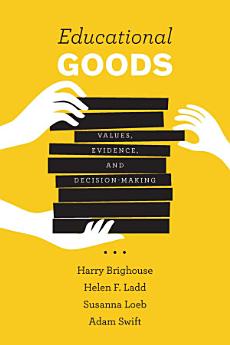
Educational Goods: Values, Evidence, and Decision-Making
Jan 2018 · University of Chicago Press
Ebook
200
Pages
family_home
Eligible
info
About this ebook
"An ambitious effort that succeeds in providing a fundamentally new way to talk about and . . . think about policy choices in education." —Jeffrey R. Henig, Teachers College, Columbia University
We spend a lot of time arguing about how schools might be improved. But we rarely take a step back to ask what we as a society should be looking for from education—what exactly should those who make decisions be trying to achieve?
In Educational Goods, two philosophers and two social scientists address this very question. They begin by broadening the language for talking about educational policy: "educational goods" are the knowledge, skills, and attitudes that children develop for their own benefit and that of others; "childhood goods" are the valuable experiences and freedoms that make childhood a distinct phase of life. Balancing those, and understanding that not all of them can be measured through traditional methods, is a key first step. From there, they show how to think clearly about how those goods are distributed and propose a method for combining values and evidence to reach decisions. They conclude by showing the method in action, offering detailed accounts of how it might be applied in school finance, accountability, and choice. The result is a reimagining of our decision making about schools, one that will sharpen our thinking on familiar debates and push us toward better outcomes.
"Every education decision-maker—and every education researcher—would benefit from reading this book." —David N. Figlio, School of Education and Social Policy, Northwestern University
"Imaginative, informative, and unfailingly constructive." —Michael S. McPherson, co-author of Lesson Plan: An Agenda for Change in American Higher Education
"An ambitious effort that succeeds in providing a fundamentally new way to talk about and . . . think about policy choices in education." —Jeffrey R. Henig, Teachers College, Columbia University
We spend a lot of time arguing about how schools might be improved. But we rarely take a step back to...
Discover more
About the author
Harry Brighouse is professor of philosophy, affiliate professor of educational policy studies, and Dickson Bascom Professor of the Humanities at the University of Wisconsin–Madison. Helen F. Ladd is professor emerita at Duke University. Susanna Loeb is the Barnett Family Professor of Education at Stanford University. Adam Swift is professor of political theory at the University of Warwick.
Harry Brighouse is professor of philosophy, affiliate professor of educational policy studies, and Dickson Bascom Professor of the Humanities at the University of Wisconsin–Madison. Helen F. Ladd is professor emerita at Duke University. Susanna Loeb is the Barnett Family Professor of Education at...
Rate this ebook
Tell us what you think.
Reading information
Smartphones and tablets
Install the Google Play Books app for Android and iPad/iPhone. It syncs automatically with your account and allows you to read online or offline wherever you are.
Laptops and computers
You can listen to audiobooks purchased on Google Play using your computer's web browser.
eReaders and other devices
To read on e-ink devices like Kobo eReaders, you'll need to download a file and transfer it to your device. Follow the detailed Help Center instructions to transfer the files to supported eReaders.