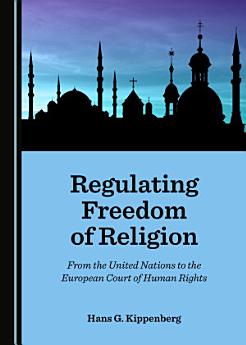
Regulating Freedom of Religion: From the United Nations to the European Court of Human Rights
Jun 2021 · Cambridge Scholars Publishing
Ebook
200
Pages
family_home
Eligible
info
About this ebook
Freedom of Religion—declared in Art. 18 of the Universal Declaration of Human Rights (1948)—concerned not only individuals, but included the moral right of religious communities to manifest religion in public. The International Covenant on Political and Civil Rights (1966/1976) made it a legal right and added an article that allowed states to restrict that freedom, provided it violates national laws and public order. This article resulted in an ongoing process of legal proceedings. The Human Rights Committee of the UN and the European Court of Human Rights have made judgments that allowed a plurality of religions in public, even in cases where there is a state religion. A declaration of the UN against intolerance and discrimination empowered religious communities to establish charitable institutions, to disseminate internationally relevant publications, and to receive financial contributions, and made them powerful social and political actors. The same declaration defended the principles of free choice of a religion and of tolerance among citizens of different faiths.
This book investigates the most relevant rulings concerning the religious rights of individuals and communities. It fills a gap in the study of religious communities in the globalized world, and will be of interest to anyone involved in historical, social, legal, and religious studies. It will help the reader to understand the paradox of the power of religious communities in a secular and globalizing world.
Freedom of Religion—declared in Art. 18 of the Universal Declaration of Human Rights (1948)—concerned not only individuals, but included the moral right of religious communities to manifest religion in public. The International Covenant on Political and Civil Rights (1966/1976) made it a legal ri...
Discover more
About the author
Hans G. Kippenberg served as Professor for Theory and History of Religions at the University Groningen, the Netherlands, from 1977 to 1989 and at the University of Bremen from 1989 to 2004. In addition to serving as Wisdom Professor at the Jacobs University Bremen, Germany, from 2008 to 2015, he also worked as a Research Fellow at the Netherlands Institute for Advanced Study in Wassenaar, the Wissenschaftskolleg Berlin, the Institute for Advanced Study, Princeton, and the Max Weber Kolleg, Germany. His English publications include Discovering Religious History in the Modern Age (2002); The 9/11 Handbook: Annotated Translation and Interpretation of the Attackers’ Spiritual Manual (with Tilman Seidensticker, 2006); Violence as Worship: Religious Wars in the Age of Globalization (2011); and The Humanities between Global Integration and Cultural Diversity (edited with Birgit Mersmann, 2016).
Hans G. Kippenberg served as Professor for Theory and History of Religions at the University Groningen, the Netherlands, from 1977 to 1989 and at the University of Bremen from 1989 to 2004. In addition to serving as Wisdom Professor at the Jacobs University Bremen, Germany, from 2008 to 2015, he ...
Rate this ebook
Tell us what you think.
Reading information
Smartphones and tablets
Install the Google Play Books app for Android and iPad/iPhone. It syncs automatically with your account and allows you to read online or offline wherever you are.
Laptops and computers
You can listen to audiobooks purchased on Google Play using your computer's web browser.
eReaders and other devices
To read on e-ink devices like Kobo eReaders, you'll need to download a file and transfer it to your device. Follow the detailed Help Center instructions to transfer the files to supported eReaders.