About this ebook
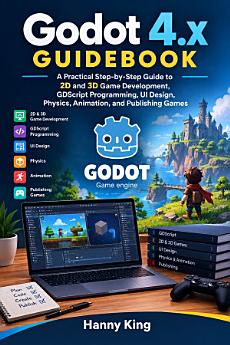
A Practical Step-by-Step Guide to 2D and 3D Game Development, GDScript Programming, UI Design, Physics, Animation, and Publishing Games
Creating games can seem complicated when you are faced with scenes, nodes, scripts, physics systems, animations, user interfaces, and countless development tools. Godot 4.x Guidebook provides a practical and approachable path for beginners and aspiring game developers who want to learn how to build games with the Godot Engine.
This guide takes you through the essential concepts of Godot game development, starting with the fundamentals of the Godot editor and gradually moving into more advanced areas of game creation. You will learn how Godot's scene and node systems work, how to organize projects, and how to create interactive game environments.
The book also introduces GDScript programming, helping you understand variables, functions, conditions, loops, signals, input handling, and other programming concepts needed to bring your games to life. You will discover how to connect scripts to game objects and create responsive gameplay mechanics.
Whether you are interested in 2D or 3D game development, this guide explores the tools and techniques needed to create playable projects. You will learn about character movement, cameras, collisions, physics, animations, user interfaces, audio, game interactions, and other important components of a complete game.
You will also explore practical approaches to designing menus, HUDs, buttons, health displays, score systems, and other UI elements. The guide explains how different Godot systems work together so you can move from individual features to a more complete game project.
Inside This Guide, You Will Learn:
The fundamentals of Godot 4.x and the Godot editor
How scenes, nodes, resources, and projects work
Creating and organizing 2D game projects
Building 3D environments and gameplay
The fundamentals of GDScript programming
Variables, functions, conditions, loops, and signals
Player movement and input handling
Collision detection and physics
Cameras and interactive game objects
Creating animations and animated characters
Designing menus, HUDs, buttons, and other UI elements
Working with audio and game effects
Organizing game projects efficiently
Creating interactive gameplay mechanics
Testing and debugging your games
Preparing games for export and publishing
Practical considerations for turning a project into a playable game
The book is written with a step-by-step, practical approach, making it useful for readers who are new to Godot as well as developers who want a structured reference for the major features of Godot 4.x.
Whether you want to build a simple 2D platformer, experiment with 3D environments, learn GDScript, or take your first game toward publication, Godot 4.x Guidebook gives you a solid foundation for exploring modern game development with Godot.
Start learning, start creating, and turn your game ideas into playable experiences with Godot 4.x.