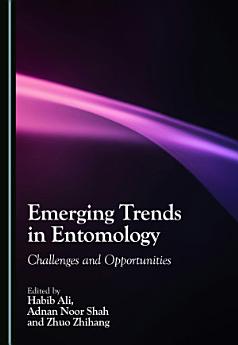
Emerging Trends in Entomology: Challenges and Opportunities

· ·
· Cambridge Scholars Publishing
Ebook
524
Pages
Eligible

About this ebook

Insects are central to our ecosystems, agriculture, and health systems, but today, entomology stands at a critical crossroads. This book presents a timely and comprehensive exploration of the pressing issues, groundbreaking research, and future pathways that are shaping the science of insects.

Divided into five thematic parts, this volume begins with a foundational overview of entomology's historical context before delving into current global challenges, including insecticide resistance, invasive species, pollinator decline, and the impacts of climate change. Readers will explore the ecological roles of insects, advances in forensic and forest entomology, and the management of disease vectors.

With a focus on innovation, the book examines state-of-the-art methodologies, including biotechnological tools, molecular genetics, remote sensing, and Geographic Information System applications, alongside integrated pest management strategies. Real-world case studies from urban ecosystems, sustainable agriculture, and conservation efforts illustrate practical applications and lessons learned. Finally, the volume looks forward to highlighting emerging technologies, policy implications, and the grand challenges that define the future of entomology. Ideal for researchers, students, policy makers, and practitioners, this book offers a vital resource for understanding and navigating the evolving landscape of insect science in the 21st century.

Insects are central to our ecosystems, agriculture, and health systems, but today, entomology stands at a critical crossroads. This book presents a timely and comprehensive exploration of the pressing issues, groundbreaking research, and future pathways that are shaping the science of insects. Di...

Discover more

About the author

Dr Habib Ali is a distinguished researcher currently serving at Khwaja Fareed University of Engineering and Information Technology, Rahim Yar Khan, Pakistan. He completed his undergraduate studies at the University of Agriculture, Faisalabad, Pakistan, with a specialisation in Agricultural Entomology. In December 2018, he earned his PhD in Agricultural Entomology and Insect Pest Control from Fujian Agriculture and Forestry University (FAFU), Fujian, China. Dr. Ali has authored over 150 national and international research papers in high-impact journals, published more than 10 books, contributed to over 35 book chapters, and has edited several volumes with reputable international publishers.

Dr Adnan Noor Shah obtained his PhD (Agronomy) from Huazhong Agriculture University, Wuhan, China in 2017. His specialization includes plant nutrition, plant-soil interaction, crop physiology, crop cultivation and farming systems, crop ecology, and plant abiotic stress responses. In addition to this, he works on plant genomics and epigenetics. He also served as Assistant Professor at Gomal University, Dera Ismail Khan, Pakistan from 2018-2019.

Dr Zhuo Zhihang currently serves as an Associate Professor at the College of Life Science, China West Normal University, Sichuan, China. He obtained his PhD from Sichuan Agricultural University, China, in 2017. Since then, he has held various positions including Lecturer, Associate Professor, Head of the Forest Protection Department, and Deputy Town Mayor in different regions of China.
Dr Habib Ali is a distinguished researcher currently serving at Khwaja Fareed University of Engineering and Information Technology, Rahim Yar Khan, Pakistan. He completed his undergraduate studies at the University of Agriculture, Faisalabad, Pakistan, with a specialisation in Agricultural Entomo...

Rate this ebook

Tell us what you think.

Reading information

Smartphones and tablets
Install the Google Play Books app for Android and iPad/iPhone. It syncs automatically with your account and allows you to read online or offline wherever you are.
Laptops and computers
You can listen to audiobooks purchased on Google Play using your computer's web browser.
eReaders and other devices
To read on e-ink devices like Kobo eReaders, you'll need to download a file and transfer it to your device. Follow the detailed Help Center instructions to transfer the files to supported eReaders.