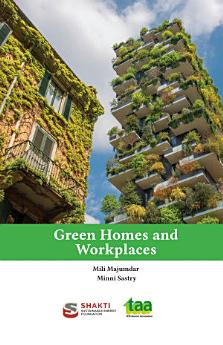
Green Homes and Workplaces
关于此电子书
Living in a hot and dry climate? You need thick walls and shaded windows. Living along a coast? The warm and moist climate means you need ample ventilation and thin walls.
These are obvious solutions but architects have more tricks up their sleeves. After having helped many buildings to being certifiably ‘green’, the authors of this book explain what sustainable buildings are and how to ensure that our homes and workplaces are not only ‘thermally comfortable’ but well-lit and well-ventilated as well. “But I have no plans to build a new home” or “I live in a rented flat”, you may say. Never mind; the book offers some useful info to you as well. For example, do not set your AC too low: approximately 27 °C is good enough, and you will save much more.
What sets Green Homes and Workplaces apart from other books is the simple and clear explanations of fundamentals and liberal use of illustrations. The authors aim to demystify the concepts and empower everyone to think and live green. For example, are you worried about polluted air indoors? Try a couple of houseplants. Living on the top floor? Try a reflective paint that can lower the inside temperature by at least a couple of degrees.
Although meant to be a guide to the concerned citizen, the book also has a more profound message: as green-buildings practitioners on the frontline of market transformation in India, the authors believe that our homes, buildings, and communities must move from not just doing less harm to becoming truly regenerative.
Contents:
- Foreword
- Preface
- Cities, buildings, people: Energy / Transport / Solid waste / Water
- Climate, built environment, and comfort: Thermal comfort / Visual comfort / Air quality index
- Water: Measures to save water / Water quality is as important as quantity
- Energy: Climate-responsive design / Energy efficiency / Designing for different climate zones of India / Cooling techniques that consume less energy / Energy-efficiency measures / Integrating renewable energy with building design
- Waste
- The 6 R’s of sustainability: Rethink / Refuse / Reduce / Reuse / Repair / Recycle / Waste treatment technologies
- Conclusion
Audience: Adults who are concerned about topical issues but lack the understanding to make sense of what they read or watch in the mass media
Shelving: Sustainable Architecture
探索更多
作者简介
Mili Majumdar is Managing Director, Green Business Certification Institute Pvt. Ltd, India and Senior Vice President, US Green Business Council, currently responsible for development, adaptation, and outreach of LEED (Leadership in Energy and Environmental Design) and other sustainability rating systems of GBCI and USGBC. Mili brings to her job more than three decades of experience in the field of energy and environment and has led global teams to develop portfolios of sustainability rating systems for habitats and allied systems widely accepted globally. Mili was recognized as the Realty Plus Woman Icon in Sustainability 2021.
Minni Sastry has been working in the field of green buildings since 18 years; obtained her master’s degree in environment and energy studies from the AA School of Architecture, London; and teaches sustainable building design to undergraduates in architecture. As a consultant to the World Bank, she recently studied a few Indian cities to identify ways to reduce the emissions of greenhouse gases and was a member of the team in TERI that developed GRIHA (Green Rating for Integrated Habitat Assessment), the national rating system for green buildings in India.