Crowds
Nov 2019 · Otbebookpublishing
Ebook
497
Pages
family_home
Eligible
info
About this ebook
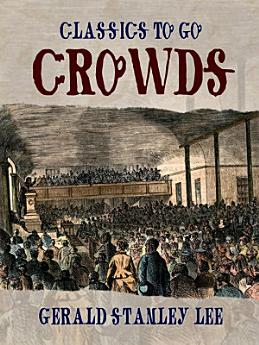
Excerpt: "The best picture I know of my religion is Ludgate Hill as one sees it going down the foot of Fleet Street. It would seem to many perhaps like a rather strange half-heathen altar, but it has in it the three things with which I worship most my Maker in this present world—the three things which it would be the breath of religion to me to offer to a God together—Cathedrals, Crowds, and Machines. With the railway bridge reaching over, all the little still locomotives in the din whispering across the street; with the wide black crowd streaming up and streaming down, and the big, faraway, other-worldly church above, I am strangely glad. It is like having a picture of one's whole world taken up deftly, and done in miniature and hung up for one against the sky—the white steam which is the breath of modern life, the vast hurrying of our feet, and that Great Finger pointing toward heaven day and night for us all.... I never tire of walking out a moment from my nook in Clifford's Inn and stealing a glimpse and coming back to my fireplace. I sit still a moment before going to work and look in the flames and think. The great roar outside the Court gathers it all up—that huge, boundless, tiny, summed-up world out there; flings it faintly against my quiet windows while I sit and think. And when one thinks of it a minute, it sends one half-fearfully, half-triumphantly back to one's work—the very thought of it. The Crowd hurrying, the Crowd's flurrying Machines, and the Crowd's God, send one back to one's work! In the afternoon I go out again, slip my way through the crowds along the Strand, toward Charing Cross. I never tire of watching the drays, the horses, the streaming taxis, all these little, fearful, gliding crowds of men and women, when a little space of street is left, flowing swiftly, flowing like globules, like mercury, between the cabs. But most of all I like looking up at that vast second story of the street, coming in over one like waves, like seas—all these happy, curious tops of 'buses; these dear, funny, way-up people on benches; these world-worshippers, sight-worshippers, and Americans—all these little scurrying congregations, hundreds of them, rolling past."
Excerpt: "The best picture I know of my religion is Ludgate Hill as one sees it going down the foot of Fleet Street. It would seem to many perhaps like a rather strange half-heathen altar, but it has in it the three things with which I worship most my Maker in this present world—the three things ...
Discover more
About the author
Gerald Stanley Lee (1862-1944) was an American clergyman, essayist, and visionary whose works explored the intersections of spirituality, industrialization, and social change. Born in Brockton, Massachusetts, Lee was a graduate of Williams College and Hartford Theological Seminary, which laid the foundation for his unique blend of religious and philosophical inquiry.Lee's writings often delved into the transformative power of human potential and the collective energy of society, making him a precursor to later thinkers who emphasized the importance of community and collaboration. His ideas were revolutionary for their time, advocating for a harmonious balance between technological progress and spiritual well-being. This perspective resonated during an era of rapid industrial growth and social upheaval, positioning Lee as a forward-thinking critic of unchecked modernization.One of the most intriguing aspects of Lee's career was his ability to influence contemporary writers and thinkers. His emphasis on the power of the individual within the collective whole found echoes in the works of later social theorists and motivational writers. Lee's vision of a society driven by shared purpose and mutual respect remains relevant, offering a counter-narrative to the often isolating effects of modern technological advancements.Despite his contributions, Lee was not without controversy. His critiques of industrial capitalism and his calls for a more spiritually attuned society were sometimes met with resistance from both religious traditionalists and staunch capitalists. Yet, it is precisely this willingness to challenge the status quo that makes Gerald Stanley Lee a figure of enduring interest, offering insights that continue to inspire debates about the balance between progress and human values.
Gerald Stanley Lee (1862-1944) was an American clergyman, essayist, and visionary whose works explored the intersections of spirituality, industrialization, and social change. Born in Brockton, Massachusetts, Lee was a graduate of Williams College and Hartford Theological Seminary, which laid the...
Rate this ebook
Tell us what you think.
Reading information
Smartphones and tablets
Install the Google Play Books app for Android and iPad/iPhone. It syncs automatically with your account and allows you to read online or offline wherever you are.
Laptops and computers
You can listen to audiobooks purchased on Google Play using your computer's web browser.
eReaders and other devices
To read on e-ink devices like Kobo eReaders, you'll need to download a file and transfer it to your device. Follow the detailed Help Center instructions to transfer the files to supported eReaders.