Sobre aquest llibre
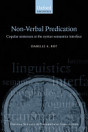
This book provides an up-to-date introduction to the study of generics and pursues the enterprise of the influential Generic Book edited by Gregory Carlson and Jeffry Pelletier, which was published in 1995. Genericity is a key notion in the study of human cognition as it reveals our capacity to organize our perceived reality into classes and to describe regularities. The generic can be expressed at the level of a word or phrase (ie the potato in The Irish economy became dependent upon the potato) or an entire sentence (eg in John smokes a cigar after dinner, the generic aspect is a property of the expression, rather than any single word or phrase within it). This book gathers new work from senior and young researchers to reconsider the notion of genericity, examining the distinct contributions made by the determiner phrase (eg the notions of kind/individual) and the verbal predicate (eg the notions of permanency, disposition, ability, habituality, and plurality). Finally, in connection with the whole sentence, the analytic/synthetic distinction is discussed as well as the notion of normality. The book will appeal to both students and scholars in linguistics, philosophy and cognitive science
This book provides an up-to-date introduction to the study of generics and pursues the enterprise of the influential Generic Book edited by Gregory Carlson and Jeffry Pelletier, which was published in 1995. Genericity is a key notion in the study of human cognition as it reveals our capacity to o...
Descobreix-ne més
Sobre l'autor
Alda Mari is a CNRS researcher at the Jean Nicod Institute in Paris. She studied Latin, Greek, Sanskrit and linguistics and obtained a PhD at the EHESS in formal semantics. Her first appointment as CNRS researcher was at the Ecole Normale Supérieure des Télécommunications in computational linguistics. She has been visiting professor at CUNY for one year. She is the author of two books on comitativity and modality. Her work in lexical and formal semantics focuses on reciprocals, generics, comitative expressions and past modals. Claire Beyssade is a CNRS researcher at the Jean Nicod Institute in Paris. She obtained a PhD in formal semantics in 1994 at the University of Caen. Her work focuses on the semantics of noun phrases, on the study of presuppositions, implicatures and other projected contents, and more recently on the semantics of intonation. She is also interested in modelisation of interpretation in terms of interaction, in formal but not denotational frameworks. She is the author of one book on the semantics of propositional attitudes and of two books, in collaboration with Carmen Dobrovie-Sorin, on indefinites. Fabio Del Prete received his PhD in philosophy from the University of Milan in 2006. He is currently a researcher in natural language semantics at the CNRS laboratory CLLE-ERSS in Toulouse, France. His research interests lie in the domains of temporal and modal expressions. He has recently worked on the interaction between temporal connectives and scalar approximative adverbs, on issues of modality underlying future tensed sentences, and on imperfective aspect in connection with habituality.
Alda Mari is a CNRS researcher at the Jean Nicod Institute in Paris. She studied Latin, Greek, Sanskrit and linguistics and obtained a PhD at the EHESS in formal semantics. Her first appointment as CNRS researcher was at the Ecole Normale Supérieure des Télécommunications in computational linguis...
Puntua aquest llibre electrònic
Dona'ns la teva opinió.
Informació de lectura
Telèfons intel·ligents i tauletes
Instal·la l'aplicació Google Play Llibres per a Android i per a iPad i iPhone. Aquesta aplicació se sincronitza automàticament amb el compte i et permet llegir llibres en línia o sense connexió a qualsevol lloc.
Ordinadors portàtils i ordinadors de taula
Pots escoltar els audiollibres que has comprat a Google Play amb el navegador web de l'ordinador.
Lectors de llibres electrònics i altres dispositius
Per llegir en dispositius de tinta electrònica, com ara lectors de llibres electrònics Kobo, hauràs de baixar un fitxer i transferir-lo al dispositiu. Segueix les instruccions detallades del Centre d'ajuda per transferir els fitxers a lectors de llibres electrònics compatibles.