Giới thiệu về sách điện tử này
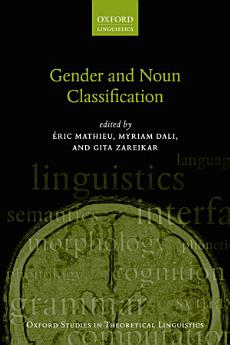
This volume explores the many ways by which natural languages categorize nouns into genders or classes. A noun may belong to a given class because of its logical or symbolic similarities with other nouns, because it shares a similar morphological form with other nouns, or simply through an arbitrary convention. The aim of this book is to establish which functional or lexical categories are responsible for this type of classification, especially along the nominal syntactic spine. The book's contributors draw on data from a wide range of languages, including Amharic, French, Gitksan, Haro, Lithuanian, Japanese, Mi'kmaw, Persian, and Shona. Chapters examine where in the nominal structure gender is able to function as a classifying device, and how in the absence of gender, other functional elements in the nominal spine come to fill that gap. Other chapters focus on how gender participates in grammatical concord and agreement phenomena. The volume also discusses semantic agreement: hybrid agreement sometimes arises due to a distinction that grammars encode between natural gender on the one hand and grammatical gender on the other. The findings in the volume have significant implications for syntactic theory and theories of interpretation, and contribute to a greater understanding of the interplay between inflection and derivation. The volume will be of interest to theoretical linguists and typologists from advanced undergraduate level upwards.
This volume explores the many ways by which natural languages categorize nouns into genders or classes. A noun may belong to a given class because of its logical or symbolic similarities with other nouns, because it shares a similar morphological form with other nouns, or simply through an arbitr...
Khám phá thêm
Giới thiệu tác giả
Éric Mathieu is Professor in the Department of Linguistics at the University of Ottawa. His research focuses on French (Modern and Old) and the Algonquian language Ojibwe. His work has appeared in journals such as Linguistic Inquiry, Natural Language and Linguistic Theory, Lingua, and Probus, and he is the co-editor, with Robert Truswell, of Micro-change and Macro-change in Diachronic Syntax (OUP, 2017). Myriam Dali is a PhD student at the University of Ottawa. Her research interests include the syntax and semantics of number and gender, the structure of the DP, the singulative, and the diachronic evolution of number marking systems. She has recently worked on the competition between plural forms in Tunisian Arabic. Her work has been published in Lingvisticae Investigationes and she has a book in preparation with John Benjamins. Gita Zareikar is a PhD candidate at the University of Ottawa. Her research interests include the syntax and semantics of bare nominals and number interpretation in general number languages. She focuses on the syntax of noun phrases and more specifically on the evolution of classifiers in non-numeral-classifier languages. She has recently been working on telicity and viewpoint aspect and its interaction with number and specificity. Her work has been published in Linguistic Variation and in the conference proceedings of NELS 46 and CLA 2015.
Éric Mathieu is Professor in the Department of Linguistics at the University of Ottawa. His research focuses on French (Modern and Old) and the Algonquian language Ojibwe. His work has appeared in journals such as Linguistic Inquiry, Natural Language and Linguistic Theory, Lingua, and Probus, an...
Xếp hạng sách điện tử này
Cho chúng tôi biết suy nghĩ của bạn.
Đọc thông tin
Điện thoại thông minh và máy tính bảng
Cài đặt ứng dụng Google Play Sách cho Android và iPad/iPhone. Ứng dụng sẽ tự động đồng bộ hóa với tài khoản của bạn và cho phép bạn đọc trực tuyến hoặc ngoại tuyến dù cho bạn ở đâu.
Máy tính xách tay và máy tính
Bạn có thể nghe các sách nói đã mua trên Google Play thông qua trình duyệt web trên máy tính.
Thiết bị đọc sách điện tử và các thiết bị khác
Để đọc trên thiết bị e-ink như máy đọc sách điện tử Kobo, bạn sẽ cần tải tệp xuống và chuyển tệp đó sang thiết bị của mình. Hãy làm theo hướng dẫn chi tiết trong Trung tâm trợ giúp để chuyển tệp sang máy đọc sách điện tử được hỗ trợ.