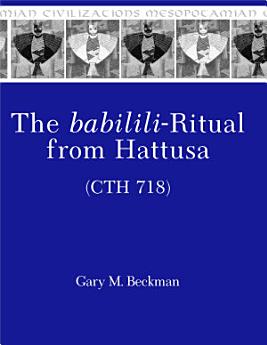
The babilili-Ritual from Hattusa (CTH 718)

· Penn State Press
Ebook
112
Pages
Eligible

About this ebook

Hittite culture of the second millennium B.C.E. was strongly influenced by Mesopotamian culture, in part through the mediation of the peripheral cuneiform civilizations of northern Syria, in part through direct contact with Babylonia and Assyria. The text edited here (CTH 718) presents an extreme example of this cultural impact, featuring incantations in the Akkadian language (Hittite babilili) embedded within a ceremony set forth in the Hittite tongue. This ritual program has therefore become known to scholars as the “babilili-ritual.”

With almost 400 preserved lines, this ceremony is one of the longest religious compositions recovered from the Hittite capital, and there are indications that a significant additional portion has been lost. The divine figure to whom the rite is addressed is Pirinkir, a variety of the well-known Ishtar of Mesopotamia. Its purpose seems to be the elimination of the sins of a member of the royal family.

Many of the ritual activities and offering materials employed here are characteristic of the cult practice of the Classical Cilician region known as Kizzuwatna, which was introduced into the central Hittite realm during the final two centuries of the state’s existence. Nonetheless, the Akkadian of the incantations is neither the Akkadian employed in the Hurrian-influenced area of Syria and eastern Anatolia nor that otherwise known from the Hittite royal archives; rather, it is closer to the language of the later Old Babylonian period, even if no precise Mesopotamian forerunners can yet be identified.

Hittite culture of the second millennium B.C.E. was strongly influenced by Mesopotamian culture, in part through the mediation of the peripheral cuneiform civilizations of northern Syria, in part through direct contact with Babylonia and Assyria. The text edited here (CTH 718) presents an extreme...

Discover more

Rate this ebook

Tell us what you think.

Reading information

Smartphones and tablets
Install the Google Play Books app for Android and iPad/iPhone. It syncs automatically with your account and allows you to read online or offline wherever you are.
Laptops and computers
You can listen to audiobooks purchased on Google Play using your computer's web browser.
eReaders and other devices
To read on e-ink devices like Kobo eReaders, you'll need to download a file and transfer it to your device. Follow the detailed Help Center instructions to transfer the files to supported eReaders.