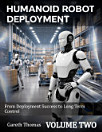
About this ebook
This one is written for people who have to make them work.
There is no hype here. No futurist pep talk. No glossy promises. This is a deployment manual — intentionally dry — because deployment punishes optimism and rewards discipline.
Humanoid robots are moving out of demos and into real environments right now: factories, warehouses, logistics sites, healthcare, and service operations. That transition is happening without mature standards, settled regulations, or stable vendor stacks.
Organizations are deploying anyway.
That is the problem this book solves.
This Is a Deployment Book, Not a Robotics Book
If you want to learn actuator design, model training, or control theory, this is not the book you want.
If you are responsible for questions like:
Will this robot run all shift without babysitting?
What breaks when we go from one unit to five?
How do we integrate with WMS, MES, and safety systems without chaos?
What do pilots actually prove — and what do they hide?
Where do costs appear after the demo succeeds?
Then this book is for you.
Most humanoid failures do not come from intelligence limits. They come from poor site preparation, bad task selection, brittle integration, underestimated maintenance, and unrealistic operational assumptions.
This book addresses those directly.
No Standards. Real Consequences.
Unlike cars, phones, or PCs, humanoid robots are being deployed before global standardization has settled. There is no IEEE playbook, no stable safety envelope, and no long-term operational norm.
That makes humanoids risky in careless deployments — and powerful in disciplined ones.
Book 1 focuses on operating inside that uncertainty:
Assessing sites not designed for humanoids
Running pilots that expose real failure modes
Selecting tasks that survive continuous operation
Integrating with enterprise systems without fragility
Scaling early fleets without losing control
Get this phase wrong and scale only magnifies the damage.
Why This Matters
Humanoid robots will not be a niche technology.
They are the first machines able to operate in environments built for humans without full redesign. That alone makes them economically different from every automation wave before them.
Cars reshaped cities. PCs reshaped offices. Mobile phones reshaped daily life.
Humanoids will reshape physical work — on Earth and beyond it.
That shift has already begun. It will grow steadily. And it will not wait for consensus.
Organizations that learn to deploy humanoids correctly in the near term will build advantages that late adopters cannot easily recover.
This book is about earning that advantage the hard way.
What You Will Find in Book 1
A hard line between demos and deployable capability
Practical site readiness and environment classification frameworks
Honest analysis of what humanoids handle well — and where they fail
Pilot designs that produce decision-grade data
Integration strategies for WMS, MES, SCADA, and enterprise IT
Operational practices that reduce human babysitting
Early scaling guidance that avoids fleet chaos
No fluff. No speculation. No filler.
Who This Book Is For
Engineers responsible for real deployments
Systems integrators and technical leads
Operations and automation managers
Decision-makers who own outcomes, not slides
If you want humanoids that work reliably in the real world, start here.
Discover more
About the author
Gareth Morgan Thomas is a qualified expert with extensive expertise across multiple STEM fields. Holding six university diplomas in electronics, software development, web development, and project management, along with qualifications in computer networking, CAD, diesel engineering, well drilling, and welding, he has built a robust foundation of technical knowledge.
Educated in Auckland, New Zealand, Gareth Morgan Thomas also spent three years serving in the New Zealand Army, where he honed his discipline and problem-solving skills. With years of technical training, Gareth Morgan Thomas is now dedicated to sharing his deep understanding of science, technology, engineering, and mathematics through a series of specialized books aimed at both beginners and advanced learners.