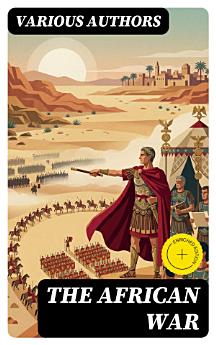
The African War (Annotated): Enriched Edition. Eyewitness Chronicles of Roman Civil War, North African Campaigns, and Military Strategy
Nov 2022 · DigiCat
Ebook
48
Pages
family_home
Eligible
info
About this ebook
The African War offers a stark, fast-moving account of the final convulsions of the Roman civil wars, following Caesar's campaign in North Africa against the Pompeian coalition and its Numidian allies. At once military narrative, political document, and ethnographic glimpse of a contested Mediterranean world, the work ranges from terse battlefield reporting to vivid scenes of siege, diplomacy, logistical hardship, and shifting allegiance. Its memorable episodes—especially the precarious engagements around Ruspina, Thapsus, and Utica—reveal how strategy, chance, and personal authority shaped republican Rome's collapse. Associated with Gaius Julius Caesar and preserved within the wider Caesarian corpus, The African War is traditionally linked to Aulus Hirtius and, in some scholarly discussions, Gaius Oppius. These figures belonged to Caesar's political and literary circle, and the text's authorship remains an important question in the study of Roman historical writing. Together, the traditions surrounding these names illuminate the collaborative, partisan, and post-conflict processes through which Caesarian memory was fashioned. The narrative consequently stands at the intersection of commentarial prose, political self-representation, and the historiography of civil war. This volume is indispensable for readers of Latin literature, Roman military history, and the late Republic. It invites close attention to competing perspectives on power, loyalty, and imperial expansion while demonstrating the compressed force of Roman campaign narrative. Readers will find in its pages both a valuable historical source and a provocative participant in the dialogue over Caesar's legacy. This enriched edition has been carefully crafted to add value to your reading experience. - A succinct Introduction situates the work's timeless appeal and themes. - The Synopsis outlines the central plot, highlighting key developments without spoiling critical twists. - A detailed Historical Context immerses you in the era's events and influences that shaped the writing. - A thorough Analysis dissects symbols, motifs, and character arcs to unearth underlying meanings. - Reflection questions prompt you to engage personally with the work's messages, connecting them to modern life. - Hand‐picked Memorable Quotes shine a spotlight on moments of literary brilliance. - Interactive footnotes clarify unusual references, historical allusions, and archaic phrases for an effortless, more informed read.
The African War offers a stark, fast-moving account of the final convulsions of the Roman civil wars, following Caesar's campaign in North Africa against the Pompeian coalition and its Numidian allies. At once military narrative, political document, and ethnographic glimpse of a contested Mediter...
Discover more
About the author
Gaius Julius Caesar (July 12 or 13, 100 BCE – March 15, 44 BCE), a towering figure of ancient history, was an accomplished Roman general, statesman, and author. His incisive military campaigns expanded the Roman Republic's dominion and his political maneuvers precipitated its transformation into the Roman Empire. His commentaries on the Gallic Wars ('Commentarii de Bello Gallico') and the Civil War ('Commentarii de Bello Civili') are not only treasured historical accounts but also exemplary pieces of Latin prose. 'The African War' ('De Bello Africo'), traditionally attributed to Caesar, is an intricate account of his campaign in North Africa, although scholarly consensus raises speculation about its provenance, with some attributing the work to an officer under Caesar, such as Aulus Hirtius. Caesar's literary style is noted for its clarity, succinctness, and commentary on military strategy and diplomacy, exemplary of the 'commentarii' genre – a forthright, factual report typical of Roman authorship. Caesar's life, marked by ambition and controversy, ended with his assassination, which ultimately catalyzed the downfall of the Roman Republic. His writings offer an invaluable glimpse into the political and military machinations of Rome and contribute to the collective understanding of this epical era in history.
Gaius Julius Caesar (July 12 or 13, 100 BCE – March 15, 44 BCE), a towering figure of ancient history, was an accomplished Roman general, statesman, and author. His incisive military campaigns expanded the Roman Republic's dominion and his political maneuvers precipitated its transformation into ...
Rate this ebook
Tell us what you think.
Reading information
Smartphones and tablets
Install the Google Play Books app for Android and iPad/iPhone. It syncs automatically with your account and allows you to read online or offline wherever you are.
Laptops and computers
You can listen to audiobooks purchased on Google Play using your computer's web browser.
eReaders and other devices
To read on e-ink devices like Kobo eReaders, you'll need to download a file and transfer it to your device. Follow the detailed Help Center instructions to transfer the files to supported eReaders.