About this ebook
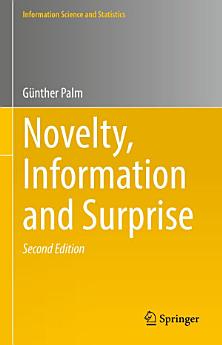
This revised edition offers an approach to information theory that is more general than the classical approach of Shannon. Classically, information is defined for an alphabet of symbols or for a set of mutually exclusive propositions (a partition of the probability space Ω) with corresponding probabilities adding up to 1. The new definition is given for an arbitrary cover of Ω, i.e. for a set of possibly overlapping propositions. The generalized information concept is called novelty and it is accompanied by two concepts derived from it, designated as information and surprise, which describe "opposite" versions of novelty, information being related more to classical information theory and surprise being related more to the classical concept of statistical significance. In the discussion of these three concepts and their interrelations several properties or classes of covers are defined, which turn out to be lattices. The book also presents applications of these concepts, mostlyin statistics and in neuroscience.
This revised edition offers an approach to information theory that is more general than the classical approach of Shannon. Classically, information is defined for an alphabet of symbols or for a set of mutually exclusive propositions (a partition of the probability space Ω) with corresponding pro...
Discover more
About the author
Günther Palm studied mathematics in Hamburg and Tübingen. After completing his studies in mathematics (Master in 1974, Ph.D. in 1975) he worked on nonlinear systems, associative memory and brain theory at the MPI for Biological Cybernetics in Tübingen. In 1983/84 he was a Fellow at the Wissenschaftskolleg in Berlin. From 1988 to 1991 he was professor for theoretical brain research at the University of Düsseldorf. Since then he has served as a professor for computer science and Director of the Institute of Neural Information Processing at the University of Ulm, where his focus is on information theory, pattern recognition, neural networks, and brain modelling.
Günther Palm studied mathematics in Hamburg and Tübingen. After completing his studies in mathematics (Master in 1974, Ph.D. in 1975) he worked on nonlinear systems, associative memory and brain theory at the MPI for Biological Cybernetics in Tübingen. In 1983/84 he was a Fellow at the Wissenscha...
Rate this ebook
Tell us what you think.
Reading information
Smartphones and tablets
Install the Google Play Books app for Android and iPad/iPhone. It syncs automatically with your account and allows you to read online or offline wherever you are.
Laptops and computers
You can listen to audiobooks purchased on Google Play using your computer's web browser.
eReaders and other devices
To read on e-ink devices like Kobo eReaders, you'll need to download a file and transfer it to your device. Follow the detailed Help Center instructions to transfer the files to supported eReaders.