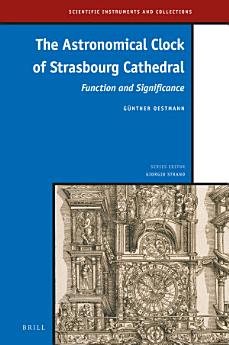
The Astronomical Clock of Strasbourg Cathedral: Function and Significance
Apr 2020 · BRILL
Ebook
344
Pages
Tools
info
About this ebook
Strasbourg Cathedral’s astronomical clock is one of the most famous monuments to Time in the world. No other clock has been described and appreciated so often and in such a myriad of ways. There were three clocks built consecutively within the cathedral: the earlier fourteenth century clock has left little trace; a second clock was realized in 1570-1574; while the nineteenth century clock began as a proposal for repairs, but was intended by its maker as a replacement clock. This book gives a detailed outline of the artistic and technical components of the second clock, much of which survives, and it describes the astronomical indications and its underlying conceptual framework. The author has discovered a hitherto disregarded contemporary statement that the clock displays four ways of determining the ascendant as described by Ptolemy. He also shows that the Strasbourg clock is the result of a highly original reception of the architectural theory of Vitruvius and other mathematical and mechanical texts of Late Antiquity.
Revised and updated translation from the German edition Die Straßburger Münsteruhr: Funktion und Bedeutung eines Kosmos-Modells des 16. Jahrhunderts. Published by GNT-Verlag in 1993.
See inside this book.
Revised and updated translation from the German edition Die Straßburger Münsteruhr: Funktion und Bedeutung eines Kosmos-Modells des 16. Jahrhunderts. Published by GNT-Verlag in 1993.
See inside this book.
Strasbourg Cathedral’s astronomical clock is one of the most famous monuments to Time in the world. No other clock has been described and appreciated so often and in such a myriad of ways. There were three clocks built consecutively within the cathedral: the earlier fourteenth century clock has l...
Discover more
About the author
Günther Oestmann, Ph.D. (1992), Technical University Berlin, is a professional clockmaker and Professor for History of Science. His fields of research are the history of scientific instruments and clocks, history of astronomy and mathematical geography, as well as maritime history.
Günther Oestmann, Ph.D. (1992), Technical University Berlin, is a professional clockmaker and Professor for History of Science. His fields of research are the history of scientific instruments and clocks, history of astronomy and mathematical geography, as well as maritime history.
Rate this ebook
Tell us what you think.
Reading information
Smartphones and tablets
Install the Google Play Books app for Android and iPad/iPhone. It syncs automatically with your account and allows you to read online or offline wherever you are.
Laptops and computers
You can listen to audiobooks purchased on Google Play using your computer's web browser.
eReaders and other devices
To read on e-ink devices like Kobo eReaders, you'll need to download a file and transfer it to your device. Follow the detailed Help Center instructions to transfer the files to supported eReaders.