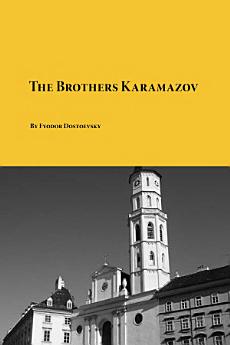
The Brothers Karamazov
Fyodor Dostoevsky
Jul 2024 · A G Printing & Publishing
Ebook
1313
Pages
About this ebook
Fyodor Pavlovitch made her an offer; inquiries were made about him and he was refused. But again, as in his first marriage, he proposed an elopement to the orphan girl. There is very little doubt that she would not on any account have married him if she had known a little more about him in time. But she lived in another province; besides, what could a little girl of sixteen know about it, except that she would be better at the bottom of the river than remaining with her benefactress. So the poor child exchanged a benefactress for a benefactor. Fyodor Pavlovitch did not get a penny this time, for the general’s widow was furious. She gave them nothing and cursed them both. But he had not reckoned on a dowry; what allured him was the remarkable beauty of the innocent girl, above all her innocent appearance, which had a peculiar attraction for a vicious profligate, who had hitherto admired only the coarser types of feminine beauty.
‘Those innocent eyes slit my soul up like a razor,’ he used to say afterwards, with his loathsome snigger. In a man so depraved this might, of course, mean no more than sensual attraction. As he had received no dowry with his wife, and had, so to speak, taken her ‘from the halter,’ he did not stand on ceremony with her. Making her feel that she had ‘wronged’ him, he took advantage of her phenomenal meekness and submissiveness to trample on the elementary decencies of marriage. He gathered loose women into his house, and carried on orgies of debauchery in his wife’s presence. To show what a pass things had come to, I may mention that Grigory, the gloomy, stupid, obstinate, argumentative servant, who had always …
Fyodor Pavlovitch made her an offer; inquiries were made about him and he was refused. But again, as in his first marriage, he proposed an elopement to the orphan girl. There is very little doubt that she would not on any account have married him if she had known a little more about him in time. ...
Discover more
About the author
One of the most powerful and significant authors in all modern fiction, Fyodor Dostoevsky was the son of a harsh and domineering army surgeon who was murdered by his own serfs (slaves), an event that was extremely important in shaping Dostoevsky's view of social and economic issues. He studied to be an engineer and began work as a draftsman. However, his first novel, Poor Folk (1846), was so well received that he abandoned engineering for writing. In 1849, Dostoevsky was arrested for being a part of a revolutionary group that owned an illegal printing press. He was sentenced to be executed, but the sentence was changed at the last minute, and he was sent to a prison camp in Siberia instead. By the time he was released in 1854, he had become a devout believer in both Christianity and Russia - although not in its ruler, the Czar. During the 1860's, Dostoevsky's personal life was in constant turmoil as the result of financial problems, a gambling addiction, and the deaths of his wife and brother. His second marriage in 1887 provided him with a stable home life and personal contentment, and during the years that followed he produced his great novels: Crime and Punishment (1886), the story of Rodya Raskolnikov, who kills two old women in the belief that he is beyond the bounds of good and evil; The Idiots (1868), the story of an epileptic who tragically affects the lives of those around him; The Possessed (1872), the story of the effect of revolutionary thought on the members of one Russian community; A Raw Youth (1875), which focuses on the disintegration and decay of family relationships and life; and The Brothers Karamazov (1880), which centers on the murder of Fyodor Karamazov and the effect the murder has on each of his four sons. These works have placed Dostoevsky in the front rank of the world's great novelists. Dostoevsky was an innovator, bringing new depth and meaning to the psychological novel and combining realism and philosophical speculation in his complex studies of the human condition.
One of the most powerful and significant authors in all modern fiction, Fyodor Dostoevsky was the son of a harsh and domineering army surgeon who was murdered by his own serfs (slaves), an event that was extremely important in shaping Dostoevsky's view of social and economic issues. He studied to...
Rate this ebook
Tell us what you think.
Reading information
Smartphones and tablets
Install the Google Play Books app for Android and iPad/iPhone. It syncs automatically with your account and allows you to read online or offline wherever you are.
Laptops and computers
You can listen to audiobooks purchased on Google Play using your computer's web browser.
eReaders and other devices
To read on e-ink devices like Kobo eReaders, you'll need to download a file and transfer it to your device. Follow the detailed Help Center instructions to transfer the files to supported eReaders.