About this ebook
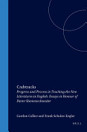
What is most strikingly new about the transcultural is its sudden ubiquity. Following in the wake of previous concepts in cultural and literary studies such as creolization, hybridity, and syncretism, and signalling a family relationship to terms such as transnationality, translocality, and transmigration, ‘transcultural’ terminology has unobtrusively but powerfully edged its way into contemporary theoretical and critical discourse. The four sections of this volume denote major areas where ‘transcultural’ questions and problematics have come to the fore: theories of culture and literature that have sought to account for the complexity of culture in a world increasingly characterized by globalization, transnationalization, and interdependence; realities of individual and collective life-worlds shaped by the ubiquity of phenomena and experiences relating to transnational connections and the blurring of cultural boundaries; fictions in literature and other media that explore these realities, negotiate the fuzzy edges of ‘ethnic’ or ‘national’ cultures, and participate in the creation of transnational public spheres as well as transcultural imaginations and memories; and, finally, pedagogy and didactics, where earlier models of teaching ‘other’ cultures are faced with the challenge of coming to terms with cultural complexity both in what is being taught and in the people it is taught to, and where ‘target cultures’ have become elusive. The idea of ‘locating’ culture and literature exclusively in the context of ethnicities or nations is rapidly losing plausibility throughout an ‘English-speaking world’ that has long since been multi- rather than monolingual. Exploring the prospects and contours of ‘Transcultural English Studies’ thus reflects a set of common challenges and predicaments that in recent years have increasingly moved centre stage not only in the New Literatures in English, but also in British and American studies.
What is most strikingly new about the transcultural is its sudden ubiquity. Following in the wake of previous concepts in cultural and literary studies such as creolization, hybridity, and syncretism, and signalling a family relationship to terms such as transnationality, translocality, and trans...
Discover more
About the author
The Chief Editors, FRANK SCHULZE–ENGLER and SISSY HELFF, teach at J.W. von Goethe University, Frankfurt.
CONTRIBUTORS: Sabrina Brancato, Nadia Butt, Sabine Doff, Gisela Feurle, Pascal Fischer, Detlev Gohrbandt, Sissy Helff, Kerstin Knopf, Ruth Mayer, Michaela Moura–Koçoğlu, Mike Phillips, Eva Ulrike Pirker, Michael C. Prusse, Virginia Richter, Kanaka Bashyam Sankaran, Katja Sarkowsky, Barbara Schaff, Edith Shillue, Frank Schulze–Engler, Axel Stähler, Mark Stein, Silke Stroh, Peter O. Stummer, Christine Vogt–William, Laurenz Volkmann, Gisela Welz, Wolfgang Welsch, Dirk Wiemann
CONTRIBUTORS: Sabrina Brancato, Nadia Butt, Sabine Doff, Gisela Feurle, Pascal Fischer, Detlev Gohrbandt, Sissy Helff, Kerstin Knopf, Ruth Mayer, Michaela Moura–Koçoğlu, Mike Phillips, Eva Ulrike Pirker, Michael C. Prusse, Virginia Richter, Kanaka Bashyam Sankaran, Katja Sarkowsky, Barbara Schaff, Edith Shillue, Frank Schulze–Engler, Axel Stähler, Mark Stein, Silke Stroh, Peter O. Stummer, Christine Vogt–William, Laurenz Volkmann, Gisela Welz, Wolfgang Welsch, Dirk Wiemann
The Chief Editors, FRANK SCHULZE–ENGLER and SISSY HELFF, teach at J.W. von Goethe University, Frankfurt.
CONTRIBUTORS: Sabrina Brancato, Nadia Butt, Sabine Doff, Gisela Feurle, Pascal Fischer, Detlev Gohrbandt, Sissy Helff, Kerstin Knopf, Ruth Mayer, Michaela Moura–Koçoğlu, Mike Phillips, Eva Ulr...
Rate this ebook
Tell us what you think.
Reading information
Smartphones and tablets
Install the Google Play Books app for Android and iPad/iPhone. It syncs automatically with your account and allows you to read online or offline wherever you are.
Laptops and computers
You can listen to audiobooks purchased on Google Play using your computer's web browser.
eReaders and other devices
To read on e-ink devices like Kobo eReaders, you'll need to download a file and transfer it to your device. Follow the detailed Help Center instructions to transfer the files to supported eReaders.