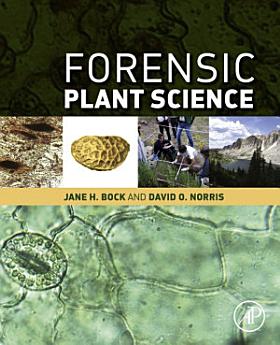
Forensic Plant Science
nov. 2015 · Academic Press
Ebook
226
Pages
family_home
Admissible
info
À propos de cet ebook
Forensic botany is the application of plant science to the resolution of legal questions. A plant's anatomy and its ecological requirements are in some cases species specific and require taxonomic verification; correct interpretation of botanical evidence can give vital information about a crime scene or a suspect or victim. The use of botanical evidence in legal investigations in North America is relatively recent. The first botanical testimony to be heard in a North American court concerned the kidnapping and murder of Charles Lindbergh's baby boy and the conviction of Bruno Hauptmann in 1935. Today, forensic botany encompasses numerous subdisciplines of plant science, such as plant anatomy, taxonomy, ecology, palynology, and diatomology, and interfaces with other disciplines, e.g., molecular biology, limnology and oceanography.Forensic Plant Science presents chapters on plant science evidence, plant anatomy, plant taxonomic evidence, plant ecology, case studies for all of the above, as well as the educational pathways for the future of forensic plant science. - Provides techniques, collection methods, and analysis of digested plant materials - Shows how to identify plants of use for crime scene and associated evidence in criminal cases - The book's companion website: http://booksite.elsevier.com/9780128014752, will host a microscopic atlas of common food plants
Forensic botany is the application of plant science to the resolution of legal questions. A plant's anatomy and its ecological requirements are in some cases species specific and require taxonomic verification; correct interpretation of botanical evidence can give vital information about a crime ...
En découvrir plus
Quelques mots sur l'auteur
Dr. Bock is a Professor emerita in biology at the University of Colorado, Boulder. She received her bachelor's degree from Duke University, master's degree from Indiana University and Ph.D. (1966) from the University of California at Berkeley. All her degrees are in Botany. She taught, carried out research and published scientific work in population ecology and forensic botany at Boulder for over 30 years. Officially retired from teaching, she continues to do research as a forensic botanist and serve as an expert witness for the defense or the prosecution in homicide cases. She also lectures and continues to publish regularly. She is a Fellow of the American Academy of Forensic Sciences, and was a founding member of both Necrosearch Ltd and the Ecology Section of the Botanical Society of America.David O. Norris is Professor Emeritus at the University of Colorado. He obtained his BS from the Baldwin-Wallace University and his PhD from the University of Washington. His broad research areas include environmental endocrinology and forensic botany. In the area of environmental endocrinology, his studies have focused on the neuroendocrine control of thyroid, adrenal, and reproductive functions with special interest in the role of environmental factors that alter the activities of these neuroendocrine systems.
Dr. Bock is a Professor emerita in biology at the University of Colorado, Boulder. She received her bachelor's degree from Duke University, master's degree from Indiana University and Ph.D. (1966) from the University of California at Berkeley. All her degrees are in Botany. She taught, carried ou...
Attribuez une note à ce ebook
Faites-nous part de votre avis.
Informations sur la lecture
Téléphones intelligents et tablettes
Installez l'appli Google Play Livres pour Android et iPad ou iPhone. Elle se synchronise automatiquement avec votre compte et vous permet de lire des livres en ligne ou hors connexion, où que vous soyez.
Ordinateurs portables et de bureau
Vous pouvez écouter les livres audio achetés sur Google Play en utilisant le navigateur Web de votre ordinateur.
Liseuses et autres appareils
Pour pouvoir lire des ouvrages sur des appareils utilisant la technologie e-Ink, comme les liseuses électroniques Kobo, vous devez télécharger un fichier et le transférer sur l'appareil en question. Suivez les instructions détaillées du centre d'aide pour transférer les fichiers sur les liseuses électroniques compatibles.