About this ebook
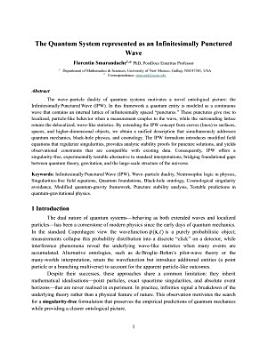
The wave–particle duality of quantum systems motivates a novel ontological picture: the Infinitesimally Punctured Wave (IPW). In this framework a quantum entity is modeled as a continuous wave that contains an internal lattice of infinitesimally spaced “punctures.” These punctures give rise to localized, particle‑like behavior when a measurement couples to the wave, while the surrounding lattice retains the delocalized, wave‑like statistics. By extending the IPW concept from curves (lines) to surfaces, spaces, and higher‑dimensional objects, we obtain a unified description that simultaneously addresses quantum mechanics, black‑hole physics, and cosmology. The IPW formalism introduces modified field equations that regularize singularities, provides analytic stability proofs for puncture solutions, and yields observational constraints that are compatible with existing data. Consequently, IPW offers a singularity‑free, experimentally testable alternative to standard interpretations, bridging foundational gaps between quantum theory, gravitation, and the large‑scale structure of the universe.
The wave–particle duality of quantum systems motivates a novel ontological picture: the Infinitesimally Punctured Wave (IPW). In this framework a quantum entity is modeled as a continuous wave that contains an internal lattice of infinitesimally spaced “punctures.” These punctures give rise to lo...
Discover more
Rate this ebook
Tell us what you think.
Reading information
Smartphones and tablets
Install the Google Play Books app for Android and iPad/iPhone. It syncs automatically with your account and allows you to read online or offline wherever you are.
Laptops and computers
You can listen to audiobooks purchased on Google Play using your computer's web browser.
eReaders and other devices
To read on e-ink devices like Kobo eReaders, you'll need to download a file and transfer it to your device. Follow the detailed Help Center instructions to transfer the files to supported eReaders.