About this ebook
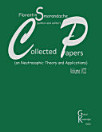
Papers collected from researchers in fusion information, such as: Florentin Smarandache, Jean Dezert, Hongshe Dang, Chongzhao Han, Frederic Dambreville, Milan Daniel, Mohammad Khoshnevisan, Sukanto Bhattacharya, Albena Tchamova, Tzvetan Semerdjiev, Pavlina Konstantinova, Hongyan Sun, Mohammad Farooq, John J. Sudano, Samuel Corgne, Gregoire Mercier, Laurence Hubert-Moy, Anne-Laure Jousselme, Patrick Maupin and others on Dezert-Smarandache Theory of Plausible and Paradoxical Reasoning (DSmT).. The principal theories available until now for data fusion are the probability theory, the fuzzy set theory, the possibility theory, the hint theory and the theory of evidence. Since last two years J. Dezert and F. Smarandache are actively developing a new theory of plausible and paradoxical reasoning, called DSmT (acronym for Dezert-Smarandache Theory), for information fusion of uncertain and highly conflicting sources of information. The DSmT can be interpreted as a generalization of the Dempster-Shafer Theory (DST) but goes far beyond the DST. The free-DSmT model, which assumes that the ultimate refinement of the frame of discernment of the fusion problem is not accessible due to the intrinsic nature of its elements, is opposite to the Shafer's model (on which is based the DST) assuming the exhaustivity and exclusivity of all elements of the frame of discernment. The DSmT proposes a new theoretical framework for data fusion based on definition of hyper-power sets and a new simple commutative and associative rule of combination. Recently, it has been discovered, through a new DSm hybrid rule of combination, that DSmT can be also extended to problems involving hybrid-models (models including some exclusivity and/or non-existentially constraints). This new important theoretical result offers now to the DSmT a wider class of fusion applications and allows potentially to attack the next generation of complex dynamical/temporal fusion problems. DSmT can also provide a theoretical issue for the fusion of neutrosophic information (extension of fuzzy information proposed by F. Smarandache in nineties - see http://www.gallup.unm.edu/~smarandache/FirstNeutConf.htm for details about the neutrosophy logic and neutrosophy set theory).
Papers collected from researchers in fusion information, such as: Florentin Smarandache, Jean Dezert, Hongshe Dang, Chongzhao Han, Frederic Dambreville, Milan Daniel, Mohammad Khoshnevisan, Sukanto Bhattacharya, Albena Tchamova, Tzvetan Semerdjiev, Pavlina Konstantinova, Hongyan Sun, Mohammad Far...
Discover more
Rate this ebook
Tell us what you think.
Reading information
Smartphones and tablets
Install the Google Play Books app for Android and iPad/iPhone. It syncs automatically with your account and allows you to read online or offline wherever you are.
Laptops and computers
You can listen to audiobooks purchased on Google Play using your computer's web browser.
eReaders and other devices
To read on e-ink devices like Kobo eReaders, you'll need to download a file and transfer it to your device. Follow the detailed Help Center instructions to transfer the files to supported eReaders.