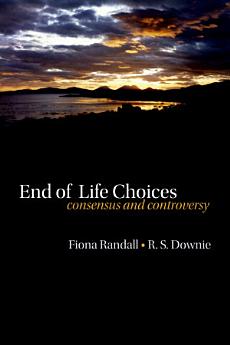
End of life choices: Consensus and controversy
Oct 2009 · OUP Oxford
Ebook
240
Pages
Tools
info
family_home
Eligible
info
About this ebook
A book for nurses, doctors and all who provide end of life care, this essential volume guides readers through the ethical complexities of such care, including current policy initiatives, and encourages debate and discussion on their controversial aspects. dived into two parts, it introduces and explains clinical decision making-processes about which there is broad consensus, in line with guidance documents issued by WHO, BMA, GMC, and similar bodies. The changing political and social context where 'patient choice' has become a central idea, and the broadened scope of potients' best interests, have added to the complexity of decision-making in end of life care. The authors discuss issues widely encountered by GPs, nurses, and hospital clinicians. These include patient choice, consent, life-prolonging treatment, and symptom relief including sedation. Part rwo explores the more controversial current end of life care initiatives, such as advance care planning preferred place of care and death, euthanais and assited suicide, extended ideas of 'best interests', and the view that there are therapeutic duties to the relatives of Throughout their discussion the authors draw attention to loose ends and contradictions in some of the proposals. Examining the current policy of comsumerist choice, they reject its place in the health service, proposing a a realistic, fair, humane and widely adoptable system of end of life care. As knowledge of ethical theories is required in training courses, and the vocabulary of ethical theory is widespread in current discussions a substantial appendix on ethical theories and terms is available online. Written by the same authors as The Philosophy of Palliative Care: Critique and Reconstruction, which won the Medical Journalists' Association Specialits Book Award 2007, this new book for non-specialists is essential reading for all health care professionals involved in providing end of life care.
A book for nurses, doctors and all who provide end of life care, this essential volume guides readers through the ethical complexities of such care, including current policy initiatives, and encourages debate and discussion on their controversial aspects. dived into two parts, it introduces and e...
Discover more
About the author
Having trained in palliative medicine at St Christopher's Hospice, London, under the leadership of Dame Cicely Saunders, Fiona Randall has been a consultant in palliative medicine since 1982. She has a special interest and academic background in health care ethics, and a philosophy PhD. Publications include 'Palliative Care Ethics' and 'The Philosophy of Palliative Care: critique and reconstruction', both Oxford University Press. She has served on the BMA Ethics Committee, and represented the Association for Palliative Medicine in consultations on the Mental Capacity Act and its Code of Practice. She has been involved in producing national guidance on advance care planning, and has given evidence to two House of Lords Select Committees on euthanasia. She serves on her Acute Hospital Clinical Ethics Committee, and teaches nationally and internationally on ethical issues in end of life care. Robin Downie was educated at the Universities of Glasgow and Oxford. Before moving into university teaching he was a Russian interpreter in the Army. He has been a member of Government and professional committees concerned with ethical issues, such as the BMA Ethics Committee and Government Committees on xenotransplantation and genetics. In addition to teaching and writing on topics in moral and political philosophy and the philosophy of science he was involved in teaching ethics to undergraduate and postgraduate medical, dental and nursing students and practitioners. Along with Sir Kenneth Calman (formerly Chief Medical Officer, UK) he began the movement now known as the 'medical humanities' i.e. the use of literature and other arts and humanities in the education of health care professionals. In particular, this way of teaching bioethics takes professionals beyond regulations, widens their perceptions of practice, and affects attitudes to patients.
Having trained in palliative medicine at St Christopher's Hospice, London, under the leadership of Dame Cicely Saunders, Fiona Randall has been a consultant in palliative medicine since 1982. She has a special interest and academic background in health care ethics, and a philosophy PhD. Publicati...
Rate this ebook
Tell us what you think.
Reading information
Smartphones and tablets
Install the Google Play Books app for Android and iPad/iPhone. It syncs automatically with your account and allows you to read online or offline wherever you are.
Laptops and computers
You can listen to audiobooks purchased on Google Play using your computer's web browser.
eReaders and other devices
To read on e-ink devices like Kobo eReaders, you'll need to download a file and transfer it to your device. Follow the detailed Help Center instructions to transfer the files to supported eReaders.