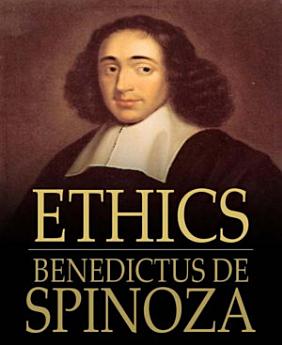
Ethics
जन॰ 2019 · BookRix
star
एक समीक्षा
ई-बुक
351
पेज
टूल
info
family_home
योग्य
info
इस ई-बुक के बारे में जानकारी
Ethics is a philosophical treatise written by Baruch Spinoza. The book closely resembles Euclid's Elements. At the beginning of Part 1, Spinoza defines key terms and lists axioms. On the basis of these and other definitions and axioms provided in the remaining four parts of the book, Spinoza offers proofs of hundreds of propositions and corollaries, such as "When the Mind imagines its own lack of power, it is saddened by it", "A free man thinks of nothing less than of death", and "The human Mind cannot be absolutely destroyed with the Body, but something of it remains which is eternal."
God or Nature consists of Attributes. God, as the complete system of Attributes, is absolutely infinite or complete; each Attribute is only infinite in its kind. By Attribute Spinoza means an ultimate or irreducible quality or energy. He names two such attributes, namely, Extension and Thought, but he allows for the possibility of an infinity of Attributes. The attributes do not belong to, but are identical with, Substance. Reality, moreover, is essentially dynamic, not static — to be is to be doing. Thus the Attribute Extension is really the whole of material energy, and the Attribute Thought is the whole of mind-energy. All material things and events are changing modes or states of Extension; and all mental events or experiences are similarly modifications or states of Thought. Each Attribute exhausts its kind of reality, in an ultimate character, activity or "world-line" of Nature, and gives rise to its entire series of objects and events in accordance with its own laws. These finite objects and events are real enough while they last, but as finite modes they change and pass; not, however, into mere nothingness, for the attribute, of which they are states, abides. The cosmic process never stops.
God or Nature consists of Attributes. God, as the complete system of Attributes, is absolutely infinite or complete; each Attribute is only infinite in its kind. By Attribute Spinoza means an ultimate or irreducible quality or energy. He names two such attributes, namely, Extension and Thought, but he allows for the possibility of an infinity of Attributes. The attributes do not belong to, but are identical with, Substance. Reality, moreover, is essentially dynamic, not static — to be is to be doing. Thus the Attribute Extension is really the whole of material energy, and the Attribute Thought is the whole of mind-energy. All material things and events are changing modes or states of Extension; and all mental events or experiences are similarly modifications or states of Thought. Each Attribute exhausts its kind of reality, in an ultimate character, activity or "world-line" of Nature, and gives rise to its entire series of objects and events in accordance with its own laws. These finite objects and events are real enough while they last, but as finite modes they change and pass; not, however, into mere nothingness, for the attribute, of which they are states, abides. The cosmic process never stops.
Ethics is a philosophical treatise written by Baruch Spinoza. The book closely resembles Euclid's Elements. At the beginning of Part 1, Spinoza defines key terms and lists axioms. On the basis of these and other definitions and axioms provided in the remaining four parts of the book, Spinoza offe...
रेटिंग और समीक्षाएं
1 समीक्षा
इस ई-बुक को रेटिंग दें
हमें अपनी राय बताएं.
पठन जानकारी
स्मार्टफ़ोन और टैबलेट
Android और iPad/iPhone के लिए Google Play किताबें ऐप्लिकेशन इंस्टॉल करें. यह आपके खाते के साथ अपने आप सिंक हो जाता है और आपको कहीं भी ऑनलाइन या ऑफ़लाइन पढ़ने की सुविधा देता है.
लैपटॉप और कंप्यूटर
आप अपने कंप्यूटर के वेब ब्राउज़र का उपयोग करके Google Play पर खरीदी गई ऑडियो किताबें सुन सकते हैं.
eReaders और अन्य डिवाइस
Kobo ई-रीडर जैसी ई-इंक डिवाइसों पर कुछ पढ़ने के लिए, आपको फ़ाइल डाउनलोड करके उसे अपने डिवाइस पर ट्रांसफ़र करना होगा. ई-रीडर पर काम करने वाली फ़ाइलों को ई-रीडर पर ट्रांसफ़र करने के लिए, सहायता केंद्र के निर्देशों का पालन करें.