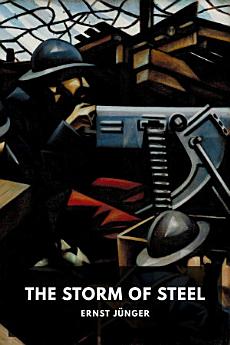
The Storm of Steel
About this ebook
Jünger begins his story as a private entering training in the Champagne region. He continues on to take part in various battles, climbing the ranks until attaining command of a regiment and accumulating fourteen different hits from bullets or shrapnel. His career ends near the very end of the war: his lung is punctured by a bullet while his men die all around him, and he’s sent to the rear to convalesce in the war’s waning months.
The realities of this new style of war are described in a matter-of-fact and mostly apolitical way. Despite the obscene horrors Jünger graphically recounts, he seems stoic, even apathetic, about his role in the war, and about the destruction it caused. As he narrates battle after battle in gruesome detail, he falls back on a sense of “war without anger,” framing himself as a cog in an emotionless machine and his enemies as deserving of respect for their valor, and not hatred for their actions. Even as his superiors issue orders that he can clearly see will lead his men into the bloody meat grinder, Jünger remains obedient, patriotic, and driven by a sense of duty and national pride.
The first edition was published in 1920, shortly after the war’s end. Jünger revised the book several times, transforming its raw diary style into a more literary one in 1924. Consequently, the book sold incredibly well, allowing Jünger to lead a post-war career as a writer. Its emphasis on nationalism made it a favorite of Nazi propagandists in the early 1930s, in contrast with Erich Maria Remarque’s equally matter-of-fact but more clearly anti-war All Quiet on the Western Front, which the Nazis banned. Jünger, who was not a Nazi, again revised it in 1934 in an attempt to make it less attractive as nationalistic propaganda, but despite his attempts the book remained a popular one both with the Wehrmacht and with the public.
This book is part of the Standard Ebooks project, which produces free public domain ebooks.