Last Words on Evolution: Restored Classics to Go Edition

· Otbebookpublishing
Ebook
115
Pages
Eligible

About this ebook

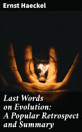
Ernst Haeckel's Last Words on Evolution is a vivid, accessible defense of evolutionary science from one of its most forceful champions. Framed as a "popular retrospect and summary," it gathers his final public lectures into a sweeping argument about the origins of life, humanity's place in nature, and the struggle between science, religion, and dogma. Translator Joseph McCabe's introduction corrects rumors that Haeckel had abandoned Darwinism and presents these lectures as a major intervention in Germany's battle between progressive science and reactionary forces. Haeckel's preface explains the urgency behind his return to public debate, driven by religious backlash and attempts to absorb evolution into doctrine. Across the book, he traces life's history through cosmology, geology, embryology, comparative anatomy, and paleontology, drawing on figures from Kant and Laplace to Lamarck, Darwin, and Huxley. With genealogical charts and striking illustrations, he argues for common descent, the unity of nature, and the biological continuity linking vertebrates, mammals, apes, and human beings. Personal recollections of research and mentorship add warmth to this polemical, scientifically grounded Monistic vision. This edition has been fully restored with modern typesetting, custom cover design.
Ernst Haeckel's Last Words on Evolution is a vivid, accessible defense of evolutionary science from one of its most forceful champions. Framed as a "popular retrospect and summary," it gathers his final public lectures into a sweeping argument about the origins of life, humanity's place in nature...

Discover more

About the author

Ernst Haeckel was a German biologist, naturalist, philosopher, and artist whose life was shaped by the great intellectual upheavals of the nineteenth century. Born in 1834, he trained in medicine before turning to zoology and eventually becoming one of Europe's most influential popularizers of evolutionary thought. A gifted lecturer and a prolific writer, he helped bring the ideas of Darwin into the wider public conversation while also making major contributions to comparative anatomy, embryology, and the classification of living organisms. His work was not limited to science alone: he was deeply interested in the relationship between nature, art, and philosophy, and his vivid illustrations helped define how many readers imagined the beauty and complexity of life. Haeckel's writing often returns to a few central concerns: the unity of all living things, the power of evolution to explain diversity, and humanity's place within the natural world. Those themes still resonate today, especially in an age grappling with environmental crisis, scientific literacy, and the search for meaning in a world shaped by biology. Though some of his views have been criticized and many of his theories have been revised, his legacy remains significant as a bridge between specialist science and public understanding. Readers interested in the history of evolution, the meeting point of science and philosophy, or the visual wonder of the natural world will find Haeckel especially rewarding.
Ernst Haeckel was a German biologist, naturalist, philosopher, and artist whose life was shaped by the great intellectual upheavals of the nineteenth century. Born in 1834, he trained in medicine before turning to zoology and eventually becoming one of Europe's most influential popularizers of ev...

Rate this ebook

Tell us what you think.

Reading information

Smartphones and tablets
Install the Google Play Books app for Android and iPad/iPhone. It syncs automatically with your account and allows you to read online or offline wherever you are.
Laptops and computers
You can listen to audiobooks purchased on Google Play using your computer's web browser.
eReaders and other devices
To read on e-ink devices like Kobo eReaders, you'll need to download a file and transfer it to your device. Follow the detailed Help Center instructions to transfer the files to supported eReaders.